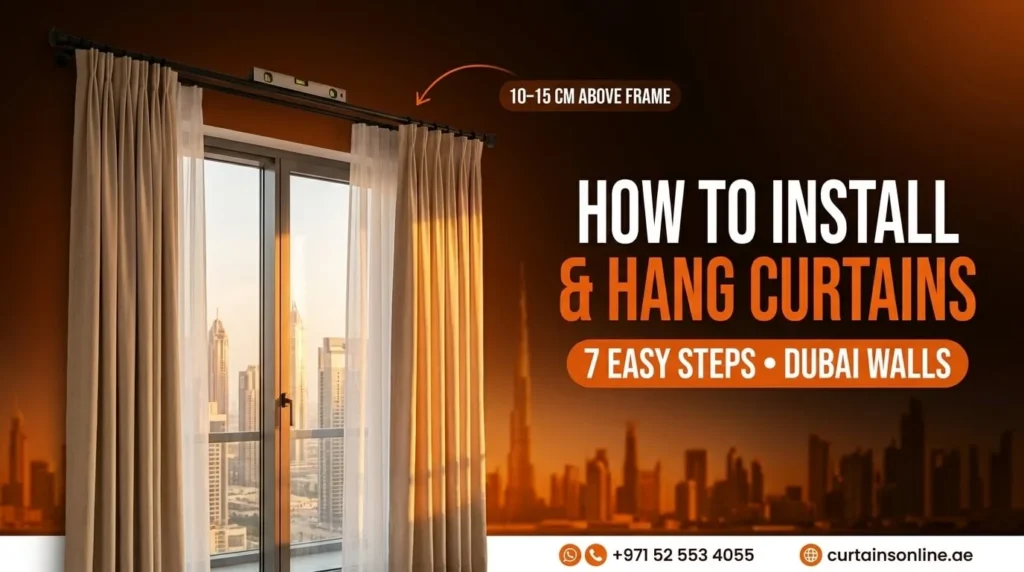
To install and hang curtains, fix your rod or track 10–15 cm (4–6 inches) above the window frame, let it extend 15–20 cm past each side, and screw the brackets into the right wall plugs for your wall. Then hang the curtains and train the folds so they fall neatly.
That is the short version. The details are where most people go wrong: the rod ends up too low, the brackets pull out of a gypsum wall, or the curtains look short and narrow.
This guide walks you through every step in plain words, with exact measurements in cm and inches, the right plugs for Dubai walls, and easy options if you rent and cannot drill.
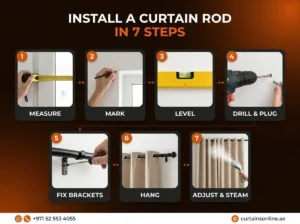
Quick Answer: How to Install and Hang Curtains in 7 Steps
- Measure the window width and the height from the floor.
- Mark the bracket points 10–15 cm above the frame and 15–20 cm past each side.
- Check the marks are level with a spirit level.
- Drill the holes and push in wall plugs that suit your wall.
- Screw the brackets on tightly, adding a centre bracket on wide windows.
- Hang the curtains on the rod or track.
- Adjust the height and train the folds for a neat finish.
Tools You Need to Hang Curtains
You need a drill, the right wall plugs, a tape measure and a spirit level. Everything else just makes the job easier. Gather it all before you start so you are not climbing up and down the ladder.

- ☐ Tape measure
- ☐ Pencil
- ☐ Spirit level (or a level app on your phone)
- ☐ Drill with a masonry bit for concrete or block walls
- ☐ Wall plugs to suit your wall (see the wall table below)
- ☐ Screws (usually come with the brackets)
- ☐ Screwdriver or drill driver
- ☐ Step ladder
- ☐ Pipe and wire detector, so you do not drill into hidden cables
- ☐ Curtain rod or track, brackets and hooks or rings
- ☐ Steamer or iron, for creases after hanging
Safety tip: Never drill straight above or below a light switch or socket. Cables often run vertically from them.
The Golden Rules: How High and How Wide to Hang Curtains
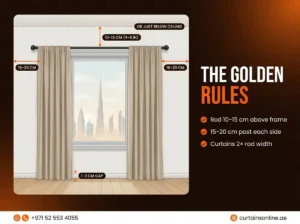
Hang the rod 10–15 cm above the window frame and let it extend 15–20 cm past each side. This one rule makes windows look taller and wider, and lets the open curtains clear the glass so more light comes in.
| Measurement | Rule | In inches | Why |
| Rod height | 10–15 cm above the frame | 4–6 in | Makes the window look taller |
| High ceiling look | Halfway between frame and ceiling, or just below the ceiling | — | Makes the room feel bigger |
| Rod width | 15–20 cm past each side of the frame | 6–8 in | Open curtains clear the glass |
| Curtain width | About 2× the rod length | 2× | Full, rich folds when closed |
| Floor gap (“float”) | 1–2 cm above the floor | ½–¾ in | Clean, modern, easy to clean |
| “Kiss” | Just touching the floor | 0 | Tailored look, needs exact measuring |
| “Puddle” | 5–15 cm on the floor | 2–6 in | Luxury look, collects dust |
Retailers agree on the basics. JYSK suggests 10 cm (4″) above the frame for a tailored look, or 25 cm (10″) to make a room feel larger. Umbra suggests 10 cm above the frame or halfway up to the ceiling.
Dubai tip: Many Dubai apartments have a gypsum false ceiling with a ready-made curtain pocket (a recess near the window). If you have one, fix a ceiling track inside it. Your curtains will run from ceiling to floor, which looks taller and blocks more heat and glare.
Need exact numbers for your window? Follow our step-by-step guide on how to measure for curtains.
How to Install a Curtain Rod: Step by Step
Installing a curtain rod takes about 30–45 minutes per window. Here is exactly how to do it.
Step 1: Measure the window
Measure the width of the window frame and the height from the floor to the top of the frame. Write both down. Then add 30–40 cm to the width (15–20 cm per side) to get your rod length.
Step 2: Mark the bracket positions
Measure 10–15 cm up from the top corner of the frame and 15–20 cm out to the side. Make a small pencil mark. Do the same on the other side.
Step 3: Check the marks are level
Place a spirit level between the two marks. Floors and window frames in older buildings are not always straight, so trust the level, not the frame.
Step 4: Drill and plug the holes
Hold a bracket on the mark and mark the screw holes through it. Drill the holes, then tap in wall plugs that match your wall type (see the next section). The plug should sit flush with the wall.
Step 5: Screw on the brackets
Screw the brackets in firmly. On windows wider than about 1.8–2.4 m, or with heavy blackout curtains, add a centre bracket so the rod does not sag. Many fitters add a centre support every 1 to 1.2 metres on wide or heavy curtains.
Step 6: Hang the curtains
Slide the curtains, rings or eyelets onto the rod. Place the rod in the brackets and tighten any locking screws. Add the finials (end caps).
Step 7: Adjust and dress the curtains
Check the hem height, open and close the curtains a few times, and steam out any creases. See the pro tips below for how to “train” the folds.
How to Install a Curtain Track
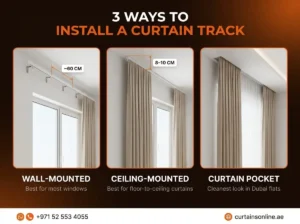
A curtain track is fitted with more brackets than a rod, placed close together along its length. Tracks suit wide windows, bay windows, ceiling-to-floor curtains and motorized systems. Not sure which you need? Compare them in track or rod.
Wall-mounted track
- Mark a level line 10–15 cm above the frame, running 15–20 cm past each side.
- Mark bracket points along the line. Track makers often space brackets around every 60 cm. Always follow the spacing in your track’s instructions.
- Drill, plug and screw on the brackets.
- Clip the track into the brackets and lock it in place.
- Slide the gliders (runners) in, fit the end stops, then hook on the curtains.
Ceiling-mounted track
- Mark a straight line on the ceiling about 8–10 cm out from the wall, so the curtains clear the window sill.
- Find what is above the ceiling. On a concrete slab, use masonry plugs. On a gypsum false ceiling, fix into the metal frame behind it or use gypsum anchors (more on this below).
- Screw the brackets or the track directly to the ceiling.
- Clip in the track, add gliders and end stops, and hang the curtains.
Inside a curtain pocket
If your room has a gypsum curtain pocket, measure its depth first. A single track needs a shallow pocket; a double track (sheer + blackout) needs a deeper one. Fix the track to the top of the pocket, keeping it straight and centred.
Planning a motorized system instead? The motor adds weight and needs a power point near the track. See motorized curtains before you drill. For more on track types, read our guide to curtain tracks.
How to Install Curtain Rods With Anchors on Dubai Walls
The right wall plug matters more than the rod. Most curtains fall down because the plug did not suit the wall, not because the bracket broke.
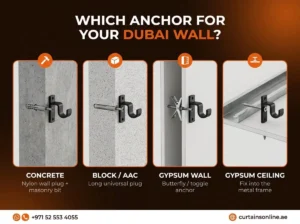
Dubai homes often mix several wall types in one flat. A UAE fixings guide lists dense concrete columns, AAC block partitions, gypsum board stud walls and marble cladding, often on the same floor. So check your wall before you buy plugs.
How to tell what your wall is made of
- Knock on it. A hollow sound means gypsum board. A dull, solid sound means block or concrete.
- Drill a test hole. White powder and easy drilling means gypsum or AAC block. Grey dust and hard drilling means concrete.
Which anchor to use
| Wall type | How it feels when drilling | Best anchor | Tip |
| Concrete | Hard, grey dust | Nylon wall plug (Fischer/Rawl type) with masonry drill bit, or a concrete anchor for heavy curtains | Use hammer mode on the drill |
| Block / AAC block | Fairly easy, light grey or white dust | Universal or long plug made for aerated blocks | Do not over-tighten, the hole can widen |
| Gypsum board wall | Very easy, white powder, hollow behind | Butterfly (toggle) or gypsum anchor | Find a metal stud for heavy curtains |
| Gypsum false ceiling | Very easy, hollow above | Gypsum anchor, or fix into the metal frame above | Never hang heavy curtains from gypsum alone |
| Wooden frame or pelmet | Easy, wood shavings | Wood screws, no plug needed | Pre-drill to stop the wood splitting |
Butterfly or toggle plugs are made for hollow walls like gypsum, because they open behind the board and spread the load. Standard nylon wall plugs suit concrete, while plastic anchors are made for drywall. You can find both at most Dubai hardware stores.
Heavy blackout or double curtains? If the wall is gypsum and you cannot find a stud, ask a fitter. A heavy curtain on the wrong anchor can pull a chunk out of the board.
How to Hang Curtains by Header Type
The header is the top of the curtain, and it decides how the curtain attaches. Check your header first, then follow the matching steps. For a full overview of styles, see types of curtains.
| Header type | Works with | Look |
| Eyelet (grommet) | Rod only | Modern, deep even folds |
| Pinch pleat | Rod with rings, or track | Formal, tailored |
| Pencil pleat | Rod with rings, or track | Classic, gathered |
| S-fold / wave | Special track only | Hotel-style, smooth waves |
| Rod pocket | Rod only | Casual, gathered (best for sheers) |
| Tab top | Rod only | Relaxed, casual |
Eyelet curtains
- Take the rod down from the brackets and remove one finial.
- Thread the curtain on, going in and out of each eyelet so the first and last folds face the wall.
- Push the end eyelet to the outside of the outer bracket, so the curtain stays put when you open it.
- Put the rod back and push the folds into even waves.
Pinch pleat curtains
- Push one hook into the back of each pleat, plus one at each end.
- Hook each one into a ring or track glider.
- Work from the centre outwards so the curtains meet neatly in the middle.
Pencil pleat curtains
- Pull the cords at the back to gather the curtain to the width you want, then tie them off. Do not cut them.
- Insert hooks into the tape about every 8–10 cm, plus one at each end.
- Choose the top, middle or bottom row of pockets to set the height. The top row hides the track; the bottom row shows the rod.
- Hook onto rings or gliders and spread the gathers evenly.
S-fold (wave) curtains
- S-fold curtains need a wave track with spaced gliders. A normal rod will not work.
- Snap the curtain tape onto each glider in order.
- Fix the end of the curtain to the track’s end stop or master carrier.
- Close the curtain and let it settle for a day or two to form even waves.
Rod pocket and tab top curtains
Slide the rod straight through the pocket or the tabs, gather the fabric evenly, and put the rod back on its brackets.
How to Hang Curtains With Hooks
Curtain hooks connect the curtain tape to rings or track gliders. Use one hook for every pocket or pleat you plan to use, and always add one at each end.
- Lay the curtain face down on a clean surface.
- Push a hook into the tape every 8–10 cm, or into each pleat.
- Pick the pocket row that gives the right hem height.
- Start at the centre of the window and hook outwards on both sides.
- Count the hooks and gliders before you start. You need one glider per hook, plus one spare at each end.
How to Hang Curtains Without Drilling
Renting in Dubai and cannot drill? You can still hang curtains, but only light ones. No-drill options hold sheers and light curtains well, not heavy blackout drapes.
| Method | How it works | Holds | Best for |
| Tension rod | A spring pushes the rod against both sides of the window recess | Light | Sheers, small windows, bathrooms |
| Adhesive hooks | Strong sticky pads on the wall hold a light rod | Very light | Short or café curtains |
| No-drill brackets (Kwik-Hang type) | Brackets tap into the top of a wooden window frame | Light to medium | Windows with a wooden frame |
| Magnetic rods | Magnets grip a metal surface | Light | Metal doors and frames |
| Ceiling tension track | Track held up by poles pressed between floor and ceiling | Medium | Room dividers |
Tension rods grip by spring pressure and are made for light loads like sheers, so heavy drapes will pull them loose over time. No-drill brackets also have limits: Kwik-Hang says its brackets are not recommended for PVC, MDF or metal trim. Many Dubai flats have aluminium window frames, so check yours first.
Tip for tenants: Ask your landlord first. Many landlords allow a few small drill holes, and filling them when you move out takes minutes.
How to Hang Sheers and Curtains Together
Use a double rod or a double track. The sheer goes on the inner rod, closest to the glass, and the main curtain goes on the outer rod. In the day, close the sheers for privacy and soft light. At night, close the main curtains for full blackout.
Mount the double brackets exactly like a single rod, but check the projection (how far it sticks out from the wall) so the two layers do not rub. Full details and fabric pairings are in layer sheer and blackout curtains.
How to Hang Curtains With Blinds
Fit the blind first, inside the window recess. Then mount the curtain rod above and outside the frame as usual, with enough projection so the curtains clear the blind. This combo is popular in Dubai bedrooms: the blind blocks the sun, and the curtains add softness. See roller blinds for blind options that pair well.
How to Hang Curtains Professionally: 7 Pro Tips
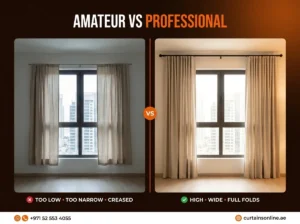
These small habits are what make curtains look “done by a professional” instead of “done on a Friday afternoon”.
- Go higher than you think. Mounting closer to the ceiling makes every room look taller.
- Go wider than the window. When open, the curtains should cover the wall, not the glass.
- Use double the width. Curtains about 2× the rod length give full, rich folds. Thin, flat curtains look cheap.
- Steam after hanging. Steam the creases out while the curtains hang. Gravity helps the fabric drop straight.
- Train the folds. Push the curtains open into even folds and tie them loosely with soft ties for 2–3 days. They will remember the shape.
- Hide the overlap. On a track, use overlap arms so the two curtains meet without a gap of light in the middle.
- Hem after hanging. Hang the curtains for a day before you hem them. Fabric can drop slightly. If they end up too long, our curtain alterations team can shorten them.
Common Curtain Hanging Mistakes (and How to Fix Them)
| Mistake | What it looks like | How to fix it |
| Rod right on top of the frame | Window looks short and squat | Move the rod 10–15 cm higher, or up near the ceiling |
| Rod the same width as the window | Open curtains block the glass | Use a longer rod, 15–20 cm past each side |
| No centre bracket | Rod bends in the middle | Add a centre bracket on wide windows or heavy curtains |
| Wrong wall plugs | Brackets wobble or pull out | Match the plug to the wall type (see the table above) |
| Curtains too short | Gap above the floor looks like a mistake | Lower the rod a little, or lengthen with a hem extension |
| Too little fabric | Flat, stretched look when closed | Use 2× the width, or add another panel |
| Track not level | Curtains drift open on their own | Re-level the brackets with a spirit level |
Already hung your curtains and something is not working? Our guide to curtain repair problems covers the most common fixes.
DIY vs Professional Curtain Installation
DIY is fine for one or two light curtains on a concrete wall. For heavy curtains, gypsum walls or ceilings, tracks and motorized systems, a professional saves time and avoids damage.
| DIY installation | Professional installation | |
| Cost | Only the hardware | Hardware + fitting from [ADD: AED X per window] |
| Time | 30–60 minutes per window, more for a first-timer | Usually 15–30 minutes per window [CONFIRM] |
| Tools | You buy or borrow them | Fitter brings everything |
| Gypsum and false ceilings | Easy to get the anchor wrong | Fitter knows where the frame is |
| Tracks and S-fold | Tricky to level and space | Done right first time |
| Finish | Depends on your skill | Level, even folds, steamed |
| If something goes wrong | You fix it | Aftercare and curtain fixing available |
Want It Done Right the First Time?
Now you know how to install and hang curtains: get the height and width right, use the right plug for your wall, and dress the folds. Follow the steps above and your curtains will look like they came from a showroom.
If you would rather skip the drill and the ladder, our team fits curtains, rods and tracks in homes and offices across Dubai. Book professional curtain installation in Dubai or call/WhatsApp +971525534055 for a free measurement visit.
About the author: at Curtains Online, has fitted curtains and tracks in +971525534055 Dubai homes and offices. See our work in the project gallery.
Frequently Asked Questions
How high should curtains be hung above the window?
Hang the rod 10–15 cm (4–6 inches) above the window frame. For a taller look, mount it halfway between the frame and the ceiling, or just below the ceiling.
How far should a curtain rod extend past the window?
About 15–20 cm (6–8 inches) on each side. This lets the open curtains sit on the wall instead of covering the glass, so more light comes in.
How many brackets do I need for a curtain rod?
Two end brackets for most windows. Add a centre bracket for rods longer than about 1.8–2.4 m or for heavy blackout curtains, and roughly one more every 1–1.2 m on very wide windows.
Can I hang curtains on a gypsum ceiling?
Yes, but fix the track to the metal frame above the gypsum, or use gypsum anchors made for ceilings. Gypsum alone cannot hold heavy curtains, so ask a fitter for blackout or double layers.
How do I hang curtains without drilling in a rented flat in Dubai?
Use a tension rod inside the window recess, adhesive hooks, or no-drill brackets on a wooden frame. These hold light curtains and sheers only. For heavy curtains, ask your landlord about a few small drill holes.
How long should curtains be?
For a clean modern look, let curtains float 1–2 cm above the floor. For a tailored look, let them just touch the floor. For a luxury look, let them puddle 5–15 cm on the floor.