The best curtains for Dubai heat are lined ones, fitted wider and longer than the window. Blackout alone is about light, not heat. What slows heat is a thermal or reflective lining, full coverage with no side gaps, and closing them before the sun reaches the glass. Fitting matters more than fabric.
Want to know what your windows need? Book a free measurement or send a photo of your window on WhatsApp. We will tell you what will actually help, and what will not.
Every July, the same thing happens in Dubai apartments. The AC runs all day, the room nearest the window never feels cool, and the DEWA bill arrives looking like a car payment. So people buy blackout curtains, hang them, and are surprised when the room is still warm.
The curtains are usually fine. The problem is that blackout and heat are two different jobs, and almost nobody selling curtains in Dubai explains the difference. Here is the honest version.
Key Takeaways
- Blackout is about light. Thermal is about heat. They are not the same word.
- The lining does the work, not the fabric you see from the room.
- Gaps ruin good curtains. Hot air moves around the sides and over the top.
- Close them before the sun hits the glass, not after the room warms up.
- DEWA says each degree on the thermostat is up to 9% off your cooling cost. That is where the saving comes from.
How Does Heat Actually Get Into Your Room?
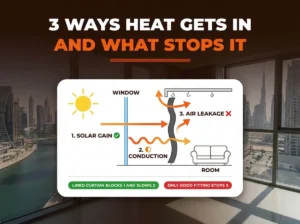
Three ways, and a curtain only deals with two of them properly.
| Route | What happens | Can a curtain help? |
| Solar gain | Sunlight passes through the glass and warms everything it lands on | Yes, this is where a lined curtain earns its money |
| Conduction | The glass itself gets hot and passes that heat inward | Partly, a thermal lining slows it |
| Air leakage | Hot air moves around the window frame and the curtain edges | Only if the curtain is fitted to block it |
That third one is why two identical curtains can perform completely differently. One is fitted wide and long and seals the window. The other is the exact width of the glass, leaving a channel of hot air on each side that pours straight into the room.
Blackout vs Thermal: The Difference Nobody Explains
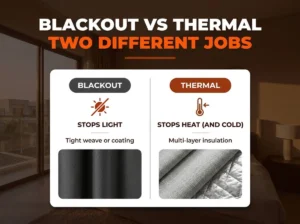
In Dubai these two words get used as if they mean the same thing. They do not.
| Blackout | Thermal | |
| What it describes | How much light the fabric blocks | How much heat the fabric slows |
| How it works | Tight weave or a coating that stops light passing | An insulating back layer, usually acrylic foam or a reflective coating |
| Good blackout gives you | A dark room at 6am in June | Nothing on its own |
| Good thermal gives you | Some light reduction | A cooler room and less work for the AC |
A thick blackout curtain does slow heat, simply because it is dense. But it is a side effect, not the design. If heat is your main complaint, ask what the back of the curtain is made of, not how dark the room goes.
The good news is that most quality curtains do both. Our blackout curtains are lined, which is why they work for heat as well as light. The point is to buy the lining on purpose, not by accident.
The Fitting Mistakes That Waste Good Curtains
Our installers see the same four problems in Dubai apartments, over and over. Fixing these matters more than upgrading the fabric.
- The curtain is only as wide as the window. It should extend well past the frame on both sides, so sun cannot come around the edge and hot air cannot circulate. Aim for at least 15 to 20 cm past the frame on each side.
- It stops at the windowsill. Floor length is better. A short curtain lets warm air roll out from under it and into the room.
- The two panels do not overlap in the middle. That vertical strip of light in the centre is also a strip of heat.
- There is a gap at the top. Mounting the track on the ceiling instead of just above the frame closes it, and makes the room look taller as well.
None of this is expensive. It is mostly a measuring decision, which is why we measure free before quoting. If your existing curtains are the right fabric but the wrong size, say so when you book a measurement and we will tell you honestly whether altering them is enough.
Which Curtain Should You Actually Buy?

Match the window to the problem rather than buying the heaviest thing in the shop.
| Your situation | What we usually fit | Why |
| Bedroom, west-facing, too hot to sleep | Lined blackout | Handles the afternoon sun and the 5am light together |
| Living room, want daylight but less heat | Sheer plus lined blackout | Sheer by day cuts glare, blackout closes when the sun comes round |
| Floor-to-ceiling glass in a high-rise | Ceiling-track blackout, wall to wall | The glass area is huge, so coverage matters more than anything |
| North-facing room | Lighter curtain or sheer | Little direct sun, so a heavy lined curtain is money you do not need to spend |
Our prices start at AED 80 per square metre for sheers and AED 120 for blackout. The sheer and blackout pairing is the most common choice in Dubai apartments, because it separates the two jobs: daylight without glare during the day, heat and light blocked when it matters. Our guide on how to layer sheer and blackout curtains covers how that works in practice.
For a full breakdown of what a room costs, see how much curtains cost in Dubai.
Does Colour Matter?
Less than people think, and not in the way they expect.
A dark curtain facing the room is fine. What matters is the side facing the glass. A light or reflective lining bounces heat back out before the fabric absorbs it. A dark single layer with no lining does the opposite: it soaks up the sun, gets hot, and then radiates that heat into your room all afternoon.
So choose the room-facing colour for how it looks, and let the lining handle the heat. That is also why fabric choice is more about feel and light than temperature. Our guide on choosing the right curtain fabric in Dubai goes through the options.
Will This Really Lower Your DEWA Bill?
Here is the honest mechanism, because the usual claims online are vague.
Curtains do not cool a room. What they do is reduce how much heat arrives, so your AC reaches the set temperature faster and runs less to hold it. The saving shows up through your thermostat.
DEWA puts a number on that part: every degree you raise the thermostat saves up to 9% on cooling, and it recommends 24°C or higher. Air conditioning accounts for up to 60% of Dubai’s electricity demand during peak afternoon hours.
So the realistic version is this. If better-fitted, properly lined curtains make a room comfortable at 24°C when you previously needed 22°C, you are looking at a meaningful cut in the cooling part of your bill. If your curtains change nothing about how the room feels, they will not change your bill either.
What we will not tell you: that curtains alone will fix a west-facing glass wall in July. They will help, noticeably. They will not replace shading, film or a better AC setup.
A Simple Routine That Costs Nothing
- Close the curtains before the sun reaches that window, not after the room is already warm. For west-facing rooms, that means late morning.
- Open them again in the evening once the sun is off the glass, so the room is not sealed up all day.
- Keep the AC at 24°C or above and let the curtains do the rest.
- Do not tuck curtains behind furniture, which opens a gap at the bottom.
What We Do
We have been fitting curtains across Dubai for over a decade, from Marina and JLT apartments to villas in Dubai Hills and the Palm.
- Book a free measurement. We come to you, measure properly and look at which way your windows face.
- We recommend what fits the problem. If a lighter option will do the job, we will say so.
- Installation, 7 days a week, 9am to 6pm, usually same day for stock fabrics.
Book your free measurement or send a photo of your window on WhatsApp.
Frequently Asked Questions
Do blackout curtains keep heat out in Dubai?
Partly. Blackout describes how much light a curtain blocks, not how much heat. A thick blackout curtain does slow heat down, but a curtain with a proper thermal or reflective lining does far more. If heat is your main problem, ask for the lining, not just the blackout rating.
What is the difference between blackout and thermal curtains?
Blackout is about light. Thermal is about temperature. A thermal curtain has an insulating back layer, usually acrylic foam or a reflective coating, that slows heat moving through the fabric. Many curtains are both, but the two words are not interchangeable, and in Dubai they are often used as if they were.
Can curtains really lower my DEWA bill?
Not on their own, but they help in a specific way. DEWA says every degree you raise the thermostat saves up to 9% on cooling. If better curtains keep the room comfortable at 24°C instead of 22°C, that is where the saving comes from. The curtain does not cool the room, it lets your AC work less.
Which curtain colour is best for heat in Dubai?
The colour you see matters less than the colour of the back. A dark fabric facing the room looks good and still works, as long as the lining facing the glass is light or reflective. A dark single layer with no lining absorbs heat and then radiates it into the room.
Do I need blackout curtains on every window?
No. Put the money where the sun is. West and south-facing windows take the worst afternoon heat in Dubai and deserve a proper lined curtain. North-facing rooms often do fine with a lighter option.
Are curtains enough for floor-to-ceiling windows?
They help a lot, because the glass area is so large, but no curtain fully solves a west-facing glass wall in July. Expect a real improvement, not a transformation. Pairing a lined curtain with a sheer layer or solar film gives the best result.
What does a heat-blocking curtain cost in Dubai?
Our blackout curtains start at AED 120 per square metre and sheers at AED 80. A sheer and blackout pairing is the most popular choice for apartments because it handles daylight and heat separately. We measure free, so you get an exact figure before you decide.
Get Your Windows Measured Free
Tell us which way your windows face and how the room feels in the afternoon, and we will tell you what will actually help. Book a free measurement or message us on WhatsApp.