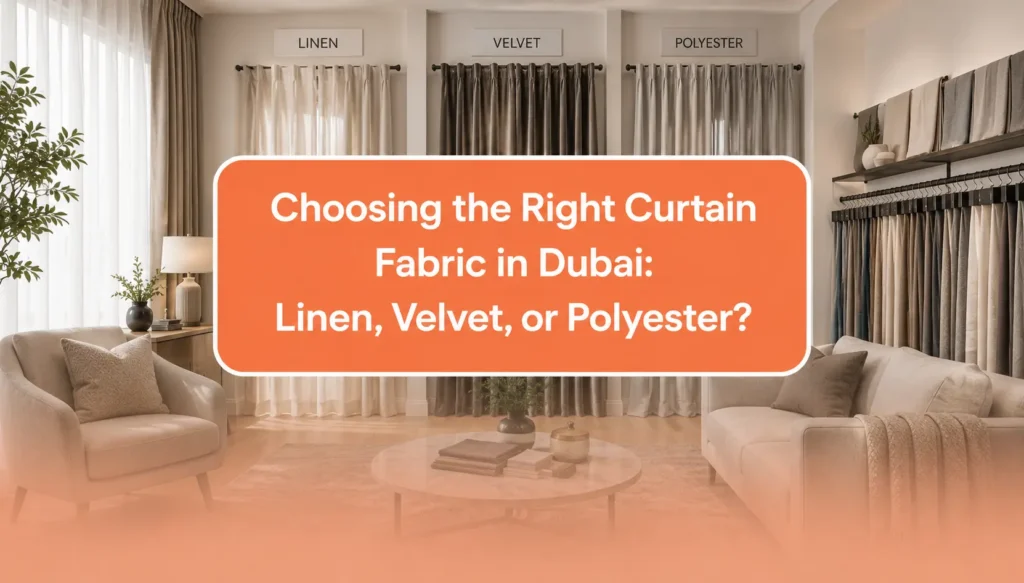
Choosing the right curtain fabric in Dubai isn’t just about style—it’s about how the material performs in the city’s harsh climate. While linen, velvet, and polyester are the most common options, each responds differently to Dubai’s intense UV rays, heat, humidity, and desert dust. Rather than one fabric being universally better, the best choice depends on your room, window, and priorities. This guide compares all three fabrics based on heat insulation, durability, UV resistance, and longevity to help you make an informed decision.
1. Why Dubai’s Climate Changes the Fabric Equation
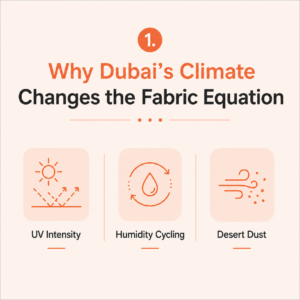
Most curtain fabric advice circulating online was written for temperate climates — markets where the primary concerns are light filtering and decor matching. Dubai introduces three additional stress factors that override conventional fabric wisdom almost entirely.
UV Intensity
Dubai’s UV index regularly exceeds 11 in summer months, among the most intense anywhere in the world. Natural fibers degrade measurably faster under this intensity than synthetic fibers do. This single factor is the reason polyester dominates the practical end of Dubai’s curtain market not because it looks better, but because it survives the sun.
Humidity Cycling
Dubai’s indoor-outdoor humidity swing is unusually extreme. Interiors are aggressively air-conditioned to 22–24°C with low relative humidity, while the exterior air, especially in summer, carries high moisture. Curtains experience this cycling daily, and fabrics that absorb moisture natural fibers especially expand and contract in response, which over time affects drape and shape.
Desert Dust
Fine sand and dust are a constant presence in Dubai’s air, far more so than in most global cities. Textured fabrics trap this dust visibly and require more frequent cleaning than smooth synthetic weaves. This is a maintenance factor that rarely appears in generic curtain advice but matters enormously to anyone who has lived in the city through a sandstorm season.
With these three factors as the backdrop, the comparison between linen, velvet, and polyester becomes much more concrete than a simple matter of taste.
2. Linen: The Breathable, Elegant Choice — and Its Real Limitations
“Linen looks effortlessly elegant in every showroom photo. The honest question is whether it looks the same way on your window after two summers.”
Linen has earned its reputation as the fabric of understated, natural elegance. Walk into any premium showroom or the best curtain shop in Dubai, and you will see its irregular, slightly textured weave catching the light beautifully. It perfectly suits the neutral, minimalist aesthetic that dominates contemporary Dubai interior design from Downtown apartments to Sustainable City villas. Made from flax fibers, linen is naturally breathable and lightweight, allowing diffused light and air circulation that heavier fabrics block entirely.
Where Linen Performs Well
- Aesthetic versatility: pairs naturally with minimalist, Scandinavian, and organic interior styles popular across Dubai
- Breathability: permits gentle air movement, useful in rooms relying on natural ventilation alongside AC
- Soft, diffused light quality: Much like high-quality sheer curtains Dubai residents use for daytime privacy, linen creates a warm ambient glow rather than harsh, direct sunlight.
- Biodegradable and considered more environmentally conscious than synthetic alternatives.
3. Velvet: The Heat-Blocking, Sound-Dampening Luxury Fabric
Velvet occupies a specific and important role in Dubai’s curtain market: it is simultaneously the most luxurious-looking fabric available and one of the most genuinely functional for the region’s climate. The common misconception — even repeated in some local curtain guides — is that velvet is “too heavy” or “not suitable” for a hot climate. The opposite is closer to the truth.
Why Velvet Performs So Well in Dubai’s Heat
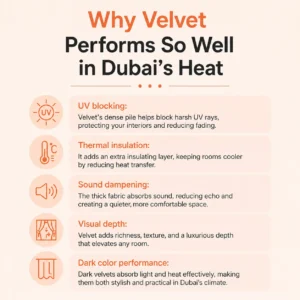
Velvet’s defining characteristic is its dense, woven pile — thousands of tightly packed fibers standing on end across the fabric surface. This structure does two things simultaneously that matter enormously in a desert climate: it blocks a very high proportion of incoming UV radiation, typically in the range of 70 to 85 percent depending on weave density and color, and it acts as a genuine thermal insulator, trapping a layer of air between the fabric and the glass that resists heat transfer into the room.
- UV blocking: 70–85% of UV radiation blocked by pile density and mass alone, even before any specialized coating
- Thermal insulation: measurably reduces room temperature on west-facing windows exposed to harsh afternoon sun
- Sound dampening : The dense pile absorbs ambient noise, a genuine secondary benefit for villas near busy roads. If traffic noise is your primary concern, you can explore specialized soundproof curtains designed specifically to block heavy city noise.
- Visual depth: rich, light-reflective surface that photographs and reads as premium in any lighting condition
- Dark color performance: navy, emerald, and burgundy velvets in particular create a near-total blackout effect suitable for bedrooms
What Velvet Asks of You in Return
Velvet’s performance comes with maintenance and structural requirements that buyers should know before ordering. The pile structure that traps UV and heat so effectively also traps dust extremely effectively — more than any other common curtain fabric. Regular soft-brush vacuuming is necessary, and the fabric should be professionally cleaned rather than home-laundered.
- Dust accumulation: the highest of the three fabrics; requires regular gentle brushing or vacuuming to maintain appearance
- Weight: a velvet panel for a standard window can weigh several kilograms, requiring a properly anchored, heavy-duty track or rod
- Humidity sensitivity: persistent dampness can cause the pile to flatten or the fabric to lose its shape over time
- Cost: velvet sits at the premium end of the price spectrum, typically AED 150–800+ per meter depending on quality and origin
- Cleaning: professional dry cleaning is recommended; home washing risks crushing the pile permanently
Curtains Online Insight: Velvet is frequently dismissed for Dubai on the assumption that “heavy fabric = hot fabric.” This is the opposite of how the physics works. A dense fabric blocks heat from entering the room far more effectively than it traps heat once inside, because the heat is intercepted at the window rather than allowed to radiate into the space. West-facing bedrooms in Dubai are, in fact, one of the best applications for velvet specifically because of this.
4. Polyester: The Climate-Resilient Workhorse
Polyester is, by a meaningful margin, the most climate-resilient curtain fabric available for Dubai’s specific conditions — and this is precisely why it dominates the volume end of the local market. It is not the most glamorous fabric on the swatch table, but it is the one that performs most predictably year after year under the exact stresses that cause linen and even velvet to show wear.
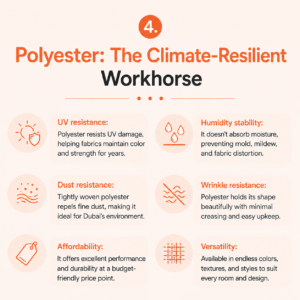
Where Polyester Genuinely Excels
- UV resistance: maintains color and fiber integrity for 5 to 8+ years before visible fading, even on unprotected south or west-facing windows
- Humidity stability: polyester does not absorb moisture, so it does not stretch, shrink, or change drape through AC-to-exterior humidity cycling
- Dust resistance: smooth synthetic fibers shed dust far more easily than textured natural weaves, simplifying maintenance significantly
- Machine wash ability: the only one of the three fabrics that most buyers can safely wash at home without professional cleaning
- Wrinkle resistance: holds its pressed shape without the creasing that affects linen
- Affordability: typically AED 25–180 per meter, making it accessible without compromising on climate performance
- Versatility: available in finishes that imitate linen’s texture or silk’s sheen, giving design flexibility without sacrificing durability
The Honest Trade-Offs
Polyester’s reputation problem is largely about perception rather than performance. Lower-grade polyester can feel stiff, slightly synthetic to the touch, and visually flat compared to natural fibers or velvet’s depth. This is a genuine consideration for formal or luxury spaces where tactile and visual richness matter as much as practicality.
- Texture: budget polyester can feel artificial; quality varies significantly by weave density and finishing
- Visual depth: lacks the natural light-play of linen or the dimensional richness of velvet at lower price points
- Heat retention if poorly chosen: lightweight, unlined polyester offers limited insulation — the blackout-backed or thicker weaves are needed for genuine thermal performance
The solution to most of these concerns is simply moving up the polyester quality tier. A well-made, mid-to-high GSM polyester with a quality weave closes much of the tactile and visual gap with natural fibers while retaining all of the climate performance advantages.
5. Master Comparison Table: Linen vs Velvet vs Polyester
The table below consolidates every performance factor covered above into a single reference. Use this as your primary decision tool before reading the room-specific recommendations that follow.
| Property | Linen | Velvet | Polyester |
| UV Resistance | Low — fades in 18–30 months unlined | High — 70–85% UV blocked by pile density | Very High — 5–8+ years before visible fade |
| Heat Insulation | Moderate — breathable, not blocking | Excellent — dense pile traps heat outside | Good — especially blackout-backed weaves |
| Humidity Behavior | Absorbs moisture, can stretch/shrink | Can lose shape if persistently damp | Dimensionally stable, unaffected |
| Dust Accumulation | High — textured weave traps dust | Highest — pile structure holds dust deeply | Lowest — smooth fibers shed dust easily |
| Maintenance | Dry clean recommended; delicate | Professional clean; brush regularly | Machine washable; low effort |
| Typical Lifespan (Dubai) | 3–5 years before replacement needed | 5–8 years with proper care | 6–10 years, most durable |
| Price per Metre (AED) | 70–220 | 150–800+ | 25–180 |
| Best Light Quality | Soft, diffused, warm natural glow | Near-total blackout in dark tones | Even, consistent diffusion |
How to read this table: No single row should be read in isolation. A fabric that scores lower on dust resistance but higher on UV resistance may still be the right choice for a north-facing room where UV exposure is minimal and dust is the dominant concern. Context always matters more than a single score.
6. Room-by-Room Fabric Recommendations
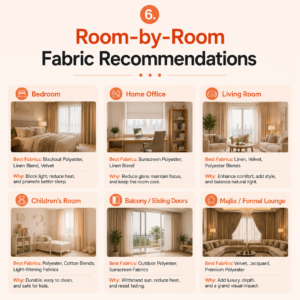
Different rooms in a Dubai home face genuinely different conditions — different sun exposure, different functional needs, and different maintenance tolerance. The table below applies the fabric science above to the specific rooms where Dubai residents most often need to make this decision.
| Room | Best Fabric | Why | Avoid |
| Bedroom (sleep priority) | Velvet or blackout-backed polyester | Maximum light block, sound dampening, thermal insulation for AC efficiency | Unlined linen — too much light penetration |
| Living Room | Linen-polyester blend | Balances natural light with UV resistance; elegant daytime look | Pure heavy velvet — can feel dark in daytime use |
| Home Office | Polyester with light-filtering weave | Reduces screen glare without full blackout; consistent light all day | Sheer-only — insufficient glare control on calls |
| Children’s Room | Polyester or poly-cotton blend | Machine washable, durable against daily handling, budget-friendly | Silk or delicate linen — high maintenance, fragile |
| Balcony / Sliding Doors | UV-treated polyester or Umbrella-type acrylic | Combines UV blocking with moisture resistance for exposed glass | Pure linen — fades fastest on the most exposed window in the home |
| Majlis / Formal Lounge | Velvet or silk-velvet blend | Visual richness, sound absorption for conversation, premium impression | Plain polyester — can look utilitarian for formal entertaining |
Curtains Online Tip: Choosing the right fabric is only half the battle; how it hangs determines the final luxury look. Whether you choose delicate linen or heavy velvet, proper tracks and precise leveling make all the difference. If you want a flawless, wrinkle-free finish, you can book our expert curtain installation team to handle the measurement and setup for you.
7. How Each Fabric Survives Dubai’s Climate Stress Test
This table isolates the four specific climate stresses unique to the UAE and shows exactly how each fabric responds, based on documented fabric behavior and field experience across hundreds of Dubai installations.
| Climate Factor | Linen Response | Velvet Response | Polyester Response |
| Summer UV (index 11+) | Visible yellowing within 18–24 months unlined | Pile absorbs UV, minimal surface fading | Resists fading 5+ years, no treatment needed |
| AC humidity cycling | Fibers expand/contract, drape changes | Generally stable unless persistently damp | No reaction — fully stable year-round |
| Desert dust exposure | Textured weave traps fine dust visibly | Deep pile traps the most dust of all three | Smooth surface; dust wipes or vacuums off easily |
| Heat gain through glass | Allows some heat transfer; airy not insulating | Best insulator; can lower room temp noticeably | Strong insulator when blackout-backed |
8. Blends: Getting the Best of Two Fabrics
One of the most significant gaps in most online guides to curtain fabric in Dubai is the absence of serious discussion about blended fabrics — despite blends being what many experienced suppliers actually recommend most often. A blend is not a compromise; in many cases it is the optimal solution, combining the aesthetic strength of one fiber with the climate resilience of another.
Linen-Polyester Blends
This is the single most requested blend in Dubai’s mid-to-premium curtain market for good reason. A linen-polyester blend retains much of linen’s natural texture and light-diffusing quality while gaining significant UV resistance and dimensional stability from the polyester content. Typical blends range from 55/45 to 70/30 linen-to-polyester ratios, with higher polyester content giving stronger climate performance at a small cost to the purely natural look.
Velvet-Polyester (Synthetic Velvet)
Modern synthetic velvets, woven primarily from polyester with a velvet-style pile structure, deliver much of velvet’s visual luxury and UV-blocking density while resisting the moisture sensitivity and high maintenance demands of natural or silk-blend velvet. For Dubai’s climate specifically, this is often the more rational premium choice over a pure natural-fiber velvet.
Silk-Polyester Blends
Silk alone is genuinely poor for Dubai’s direct sun exposure — it degrades quickly under UV and requires careful, sheltered placement. A silk-polyester blend captures silk’s characteristic sheen and drape quality while polyester’s presence substantially improves fade resistance, making formal living areas and dining rooms a realistic application without the fragility of pure silk.
Curtains Online Recommendation: If you are torn between two fabrics on this list, a quality blend is very often the answer rather than a compromise between them. We stock and custom-order linen-polyester and velvet-polyester blends specifically because they solve the climate trade-offs this guide describes, without asking the homeowner to choose between aesthetics and durability.
9. GSM, Thread Count, and Weave — What the Numbers Actually Mean
Almost no consumer-facing curtain guide in the Dubai market explains the technical specifications that actually determine fabric performance. Fabric weight, measured in grams per square meter (GSM), and weave density are the two factors that most directly predict how a fabric will behave — far more reliably than fiber type alone.
GSM (Grams per Square Meter)
- Sheer voile: typically 60–90 GSM — lightweight, diffuses light, minimal insulation or blocking properties
- Mid-weight curtain fabric (standard linen, lighter polyester): 150–250 GSM — reasonable drape with moderate light control
- Heavy curtain fabric (velvet, blackout-backed polyester): 300–500+ GSM — strong light blocking and insulation properties
As a general rule, higher GSM correlates with better heat insulation and UV blocking regardless of fiber type, because mass and density are the physical properties doing the actual blocking work. This is why a high-GSM polyester can outperform a low-GSM velvet on insulation, even though velvet has a reputation as the heavier fabric.
Weave Density
A tightly woven fabric, regardless of fiber, blocks more light and UV than a loosely woven fabric of the same material. This is why two linen curtains can perform very differently — one a tight, dense weave and another an open, airy weave — despite both being marketed simply as “linen.” When comparing fabric samples, hold them up to a light source. The less light passes through evenly, the denser the weave and the better its UV and heat-blocking performance will be.
10. Common Buying Mistakes in Dubai’s Fabric Market
- Choosing fabric by photo alone. Online product photography rarely reflects true color and texture under Dubai’s intense natural light. Always request a physical sample before committing to a full order.
- Ignoring window orientation. The same fabric choice that works beautifully on a shaded north-facing window can fail within two years on an exposed west-facing one. Orientation should drive the decision as much as room type.
- Assuming “blackout” means the same UV performance across brands. Blackout refers to light-blocking opacity, not necessarily UV resistance or heat insulation. These are related but distinct properties, and a cheap blackout fabric can still degrade quickly under UV.
- Underestimating GSM’s importance. Two fabrics of the same fiber type but different weights will perform very differently. Always ask for the GSM figure, not just the fiber name.
- Choosing pure linen for a heavily sun-exposed window without a protective lining. This is the single most common regretted purchase in Dubai’s curtain market — visible fading within two years is avoidable with the right lining specified at the time of order.
- Not asking about color-fastness testing. Reputable suppliers can tell you whether a fabric has been tested or rated for UV/color-fastness. If a supplier cannot answer this, the fabric likely has not been evaluated for Dubai’s specific conditions.
11. How to Test a Fabric Sample Before You Commit
Before finalizing any fabric order, these simple tests — conducted at home, in your own light — reveal far more than a showroom display ever can.
- Hold the sample against your actual window at the time of day the room receives the most direct sun, not in the showroom’s controlled lighting.
- Check light transmission by holding the fabric up against a bright window and noting how evenly light passes through — even, diffuse light is generally preferable to patchy hot spots.
- Crease test: scrunch a corner of the fabric in your hand for ten seconds, then release. Fabrics that release the crease quickly will look better with less daily maintenance.
- Weight test: lift the sample. A heavier, denser feel generally correlates with better insulation and UV-blocking performance.
- Ask for the GSM and weave density figures directly, and compare across the samples you are considering rather than relying on fiber name alone.
Curtains Online: Every consultation we provide includes physical fabric samples brought to your home, so you can test exactly these factors in your own light and your own room before any order is placed. Book a free consultation at curtainsonline.ae.
12. Frequently Asked Questions
Which curtain fabric is best for Dubai’s climate overall?
There is no single fabric that wins in every scenario, but polyester offers the most consistent all-round climate performance — UV resistance, humidity stability, and dust resistance — making it the most reliable default for most Dubai homes. Velvet outperforms it specifically for heat-blocking and sound dampening in bedrooms, while linen remains the preferred aesthetic choice for living spaces where some compromise on longevity is acceptable.
Does linen really fade faster in Dubai than other cities?
Yes, measurably so. Dubai’s UV index regularly exceeds 11 in summer, well above levels common in temperate climates where most linen-care guidance originates. Unlined linen on a direct-sun window typically shows visible yellowing and fibre weakening within 18 to 24 months in Dubai, compared to several years in milder climates. A UV-protective lining substantially closes this gap.
Is velvet too hot for Dubai bedrooms?
No — this is a common misconception. Velvet’s dense pile blocks 70–85% of incoming UV and acts as a genuine thermal insulator, intercepting heat at the window before it enters the room. Velvet is, in fact, one of the more effective fabrics for keeping a west-facing bedroom cooler, provided the curtain is installed correctly with no significant gaps for heat to bypass the fabric.
Can I mix fabrics within the same home?
Yes, and it is often the smarter approach. Using polyester or a linen-polyester blend in sun-exposed living areas and bedrooms, while reserving pure linen for shaded, low-exposure rooms such as a north-facing study, lets each room use the fabric best suited to its specific light and function rather than forcing one fabric to perform everywhere.
What GSM should I look for in a Dubai curtain fabric?
For everyday living rooms and bedrooms, a fabric in the 200–350 GSM range generally provides a good balance of drape, insulation, and durability. Sheers below 100 GSM are appropriate only as a layering element, not a primary window covering, given Dubai’s UV intensity. Heavier blackout or velvet fabrics above 350 GSM are appropriate where maximum light control and insulation are the priority.
Does Curtains Online offer fabric samples before I order?
Yes. Curtains Online (curtainsonline.ae) provides a free home consultation that includes physical fabric samples in linen, velvet, polyester, and blended options, shown in your own room and light before you commit to any order. This removes the single biggest source of buyer regret in Dubai’s curtain market — choosing a fabric based on a showroom or online photo that performs differently once installed.