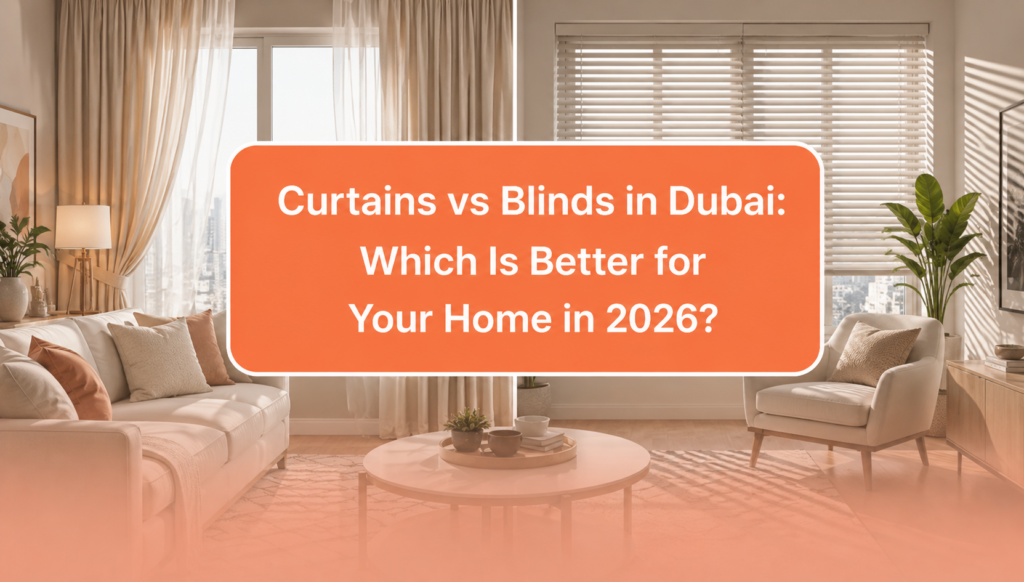
When furnishing a home in Dubai, choosing between curtains and blinds is about more than appearance. Your window treatment needs to handle extreme summer heat, block strong sunlight and UV exposure, reduce dust entering the home, and match your interior style.
Based on our experience fitting thousands of windows across Dubai apartments and villas, this guide compares curtains and blinds for 2026 across key factors including heat control, energy efficiency, privacy, maintenance, cleaning costs, lifespan, and resale value.
We also explain where curtains work best, where blinds are the smarter choice, and when combining both delivers the best results.
The Short Answer First
For most Dubai homes, curtains Dubai are the better all-round choice — especially for living rooms, master bedrooms, and large floor-to-ceiling windows — because they insulate against heat better, offer fuller privacy, and give that warm, hotel-like finish Dubai interiors are known for. Blinds win in specific spots: kitchens, bathrooms, home offices, and small or oddly shaped windows where precise daylight control and easy wiping matter more than softness. Many of our clients end up layering both, and we will explain exactly how below
Curtains vs Blinds: Side-by-Side Comparison (Dubai 2026)
Before we go deep, here is the full head-to-head at a glance. This table sums up how curtains and blinds compare on every factor that matters for a Dubai home. We explain each row in detail further below.
| Factor | Curtains | Blinds | Winner (Dubai) |
| Heat insulation / AC savings | Excellent — lined fabric blocks solar heat gain | Fair — gaps between slats leak heat (honeycomb is the exception) | Curtains |
| Light control | On/off; sheers soften light | Precise — tilt slats to any angle | Blinds |
| Night-time privacy | Full edge-to-edge coverage, no gaps | Slats leak silhouettes at night | Curtains |
| Daytime privacy | Needs sheers to keep light + privacy | Tilt slats for light plus privacy | Blinds |
| Blackout for sleep | Excellent — blocks 95–100% light | Light always leaks at edges | Curtains |
| Dust & cleaning | Vacuum weekly, wash every 6–12 months | Wipe slats often; every slat collects dust | Tie (depends on effort) |
| Moisture resistance | Poor — fabric can mildew | Excellent — PVC/aluminum wipe clean | Blinds |
| Noise reduction | Good — dense fabric absorbs sound | Poor — hard surfaces reflect sound | Curtains |
| Style / luxury feel | Warm, soft, hotel-like | Clean, modern, minimal | Depends on taste |
| Best for large/tall windows | Excellent — seamless coverage | Awkward on very wide glazing | Curtains |
| Best for small/odd windows | Fabric can bunch | Custom-cut fits precisely | Blinds |
| Cost (small window) | From AED 80 per panel | From AED 100 per window | Curtains (slightly) |
| Lifespan in UV | Long if lined; lining protects fabric | Cheap plastic warps; quality holds | Tie (quality matters) |
| Smart home / motorization | Available (motorized tracks) | Available (motorized slats) | Tie |
Why Window Treatments Matter More in Dubai Than Almost Anywhere Else

In a cooler climate, curtains and blinds are mostly about style and a bit of privacy. In Dubai, they are a working part of your home’s comfort system. Three local realities change the whole calculation:
Extreme solar heat. West and south-facing rooms get direct afternoon sun that bleaches furniture, pushes up indoor temperatures, and drives your AC — and therefore your DEWA bill — higher. The Dubai Electricity and Water Authority treats window coverings as a genuine passive-cooling measure, because a well-fitted thermal layer cuts solar heat gain noticeably.
Fine desert dust. Sand and dust find their way in through every gap, settling on fabric and into slats. The way each treatment handles dust is a daily-living issue here, not a footnote.
Glass-heavy architecture. Modern Dubai towers and villas are built with huge glazed facades and floor-to-ceiling windows. That looks stunning, but it means a lot of surface to cover and a lot of heat and glare to manage — which favors treatments that can cover edge to edge.
Heat Control and Energy Savings: Where Curtains Pull Ahead
This is the single most important factor for a Dubai home, and it is where curtains have a real, measurable edge. A floor-to-ceiling curtain with a thermal or blackout lining creates a continuous insulating barrier across the whole window, trapping a layer of air between the fabric and the glass. According to the US Department of Energy, properly fitted medium-colored draperies with reflective backing can reduce solar heat gain by around 33 percent — a meaningful cut to AC load during Dubai’s peak summer months.
Blinds manage light beautifully, but most slatted blinds leave small gaps between the slats and around the edges, so hot air slips through more easily. Solar roller blinds and honeycomb (cellular) blinds are the exceptions — honeycomb blinds in particular trap air in their cell structure and insulate well — but a standard venetian or basic roller blind will not match a thermal-lined curtain for keeping a room cool.
Curtains Online verdict: For cooling and energy efficiency in Dubai, lined curtains are the stronger performer for large and sun-facing windows. If you love the blinds look, choose honeycomb or solar roller blinds rather than basic slats.
Light Control: Where Blinds Have the Advantage
If your priority is fine, adjustable control of daylight throughout the day, blinds genuinely win. With Venetian, zebra, or roller blinds you can tilt, lift partway, or filter the angle of light without darkening the whole room — ideal when you want brightness but not glare on a TV or laptop screen.
Curtains work in a simpler open-or-closed way. You can soften this by layering sheers behind heavier panels — sheers diffuse harsh Dubai light into a soft glow during the day, and the blackout layer takes over at night — but you do not get the slat-by-slat precision blinds offer. For a home office or a bright kitchen where you adjust the light many times a day, blinds are more convenient.
Privacy: Curtains Cover Edge to Edge
Privacy is a bigger deal in Dubai than people expect, because so many apartments face neighboring towers or busy roads. Here curtains tend to come out ahead. When closed, a full curtain covers the window completely, with no gaps — you are simply not visible from outside, and a sheer-plus-blackout layered setup lets you keep daytime light without giving up privacy.
Tilted blinds, by contrast, leave small gaps between slats. During the day that is usually fine, but at night, with your indoor lights on, those gaps can let silhouettes show through to anyone outside. For street-facing bedrooms and living rooms, curtains give more complete peace of mind.
Dust and Cleaning: An Honest Look at Both
This is the factor most Dubai guides get half-right, so here is the full picture. The common claim is that blinds are easier to clean. That is only partly true.
Curtains collect dust into the fabric, so they need vacuuming with a brush attachment roughly weekly and a wash or dry-clean every six to twelve months. The upside: cleaning is occasional and largely hands-off.
Blinds do not hold dust the same way and can be wiped, but in Dubai’s dusty air every single slat collects a film that has to be wiped individually, plus the corners and the head rail. A wipe-down looks quick but takes longer than people expect, and it needs doing more often. Roller blinds (one continuous surface) are the easiest type of dubai blinds to keep clean; venetians with many slats are the most tedious.
Curtains Online verdict: There is no clear winner — it depends on effort style. Curtains need occasional deep cleaning; blinds need frequent quick wiping. In a high-dust area, roller blinds or easy-clean, tightly-woven curtain fabrics save the most hassle.
Cost in Dubai (2026 Prices in AED)
Real budgets matter more than vague advice, so here is current 2026 pricing from the Dubai market. Treat these as guide ranges; final cost depends on window size, fabric, lining, and whether you go custom-made or ready-made.
| Treatment | Typical 2026 price (AED) | Best for |
| Ready-made curtains | 80 – 500 per panel | Quick, budget furnishing |
| Custom blackout curtains | 65 – 220 per sq. meter (fitted) | Bedrooms, sun-facing rooms |
| Premium / motorized curtains | 250 – 400+ per sq. meter | Villas, large glazing |
| Roller / basic blinds | 100 – 500 per window | Kitchens, offices, small windows |
| Custom / motorized blinds | Higher; varies by size & motor | Smart homes, hard-to-reach windows |
As a rule of thumb, expect to spend AED 1,500–6,000 to curtain a two-bedroom Dubai apartment, while villas with large windows and premium or motorized options can pass AED 15,000. Blinds are often cheaper per small window, but for big windows the cost gap narrows once you add quality fabric and motorization.
A point most competitors miss: cheap, ill-fitting ready-made panels are a false economy in Dubai. Standard sizes leave gaps around sliding doors and floor-to-ceiling glass, which defeats both the blackout and the heat-blocking purpose. Made-to-measure usually pays for itself in comfort and lower AC use.
Lifespan and Durability in Dubai’s Climate
Dubai’s sun is hard on materials. Unlined or low-quality curtain fabrics can fade and weaken where the sun hits them directly, which is exactly why lining matters — it protects the decorative fabric and extends its life. Quality lined curtains comfortably last many years. Blinds made of plastic or thin aluminum can warp, discolor, or become brittle under constant heat and UV, while good wooden and quality roller blinds hold up better. Whichever you choose, UV-stable, well-made materials are worth the extra cost here because the climate punishes shortcuts.
Room-by-Room: What We Recommend in Dubai Homes

Here is our recommendation for every room at a glance, followed by the reasoning for each.
| Room | Best choice | Why |
| Living room | Curtains + sheers | Heat, privacy, premium look on big windows |
| Master bedroom | Blackout curtains + sheers | True darkness for sleep, full privacy |
| Kitchen | Blinds (roller/aluminum) | Moisture & grease resistant, easy wipe |
| Bathroom | Blinds (PVC/vinyl) | Withstands steam; no mildew risk |
| Home office | Blinds (zebra/solar) | Adjustable light, kills screen glare |
| Kids’ room / nursery | Blackout curtains (cordless) | Safe darkness for naps; no loose cords |
| Floor-to-ceiling windows | Curtains | Seamless edge-to-edge coverage |
| Small / arched windows | Custom blinds | Precise fit where fabric would bunch |
Living Room
Curtains, usually layered with sheers. Living rooms in Dubai often have the largest windows and the most sun, and they are where you most want warmth, privacy, and that premium hotel-like finish. Sheers soften daytime light; a heavier or blackout layer controls heat and evening privacy.
Master Bedroom
Curtains with blackout lining. For real darkness against early Dubai sunrise and for the best sleep, a full blackout curtain that covers edge to edge beats slatted blinds, which leak light at the gaps. Layer with sheers for daytime use.
Kitchen and Bathroom
Blinds. These rooms need moisture resistance, easy wiping, and treatments that do not get in the way. Roller or aluminum blinds in wipe able, moisture-tolerant materials are the practical pick.
Home Office and Study
Blinds, ideally zebra or solar roller. You want to tune daylight through the day and kill screen glare without going fully dark — exactly what adjustable slats and dual-layer zebra blinds do best.
Children’s Room and Nursery
Blackout curtains, for safe, cordless darkness that supports naps and longer sleep. Choose cordless or motorized options to avoid loose cords near young children.
Floor-to-Ceiling and Oddly Shaped Windows
Curtains for tall, wide, panoramic glazing; made-to-measure blinds for small, arched, or awkward shapes. Curtains flatter big windows and cover them seamlessly; precise custom blinds suit tricky frames where fabric would bunch.
The Smartest Option Most Guides Skip: Combine Both
Here is the insight that gets lost in the either-or debate: you do not have to choose. The best-performing Dubai windows we fit often use both. A common, highly effective setup is a roller or solar blind against the glass for precise daytime light control, with curtains framing the window for heat insulation, full night-time privacy, and softness. Blinds inside, curtains outside; sheers with a blackout layer behind. There is no rule — only what works for your room, your light, and your budget. For sun-facing living rooms especially, this layered approach gives you the strengths of both and the weaknesses of neither.
Smart Homes: Motorization Works for Both
If you are building or renovating in Dubai, motorization is worth considering, and importantly it is available for both curtains and blinds. Motorized tracks and motorized blind systems integrate with the same smart platforms used across Dubai’s new builds, and compatible motors work with voice assistants so you can open or close everything hands-free. For tall, hard-to-reach windows in villas and high-rise apartments, motorization is less a luxury than a practical convenience. Battery-powered options let you retrofit existing curtains without rewiring.
Quick Decision Guide
- Choose curtains if: you want maximum heat insulation, full privacy, a warm luxurious look, real blackout for sleep, or you have large floor-to-ceiling windows.
- Choose blinds if: you want precise adjustable light control, a clean minimal look, easy daily wiping in kitchens or bathrooms, or you are covering small, awkward, or moisture-prone windows.
- Choose both if: you have a sun-facing living room or master bedroom and want the best of comfort, control, and style — this is what we most often recommend.
Why Dubai Homeowners Choose Curtains Online
At Curtains Online (curtainsonline.ae), window treatments are not a side product — they are what we do. We offer free measurement and consultation across Dubai, made-to-measure curtains and blinds stitched to your exact window size, climate-appropriate fabrics chosen for heat, dust, and UV, and professional installation. Because we handle measurement, stitching, and fitting ourselves, the finished result fits with no gaps — which, as this guide has shown, is what actually makes a window treatment perform in Dubai’s climate. Whether you lean toward curtains, blinds, or a smart layered combination, our team can recommend the right solution for your space and budget.
Frequently Asked Questions
Are curtains or blinds better for Dubai’s heat?
Lined curtains are generally better for heat, because they cover the window edge to edge and trap an insulating layer of air, reducing solar heat gain and AC load. Among blinds, honeycomb (cellular) and solar roller blinds insulate best.
Which is cheaper in Dubai, curtains or blinds?
For small windows, basic blinds are often cheaper (from around AED 100 per window). For large windows, the gap narrows once you add quality fabric or motorization. Ready-made curtains start near AED 80 per panel, while custom blackout curtains start around AED 65 per square meter fitted.
Are blinds easier to clean than curtains in dusty Dubai?
Partly. Blinds can be wiped rather than washed, but every slat collects dust and needs wiping often. Curtains need only occasional vacuuming and a wash every 6–12 months. Roller blinds are the easiest blind type to keep clean.
Can I use curtains and blinds together?
Yes, and it is often the best choice in Dubai. A roller or solar blind against the glass gives precise daytime light control, while curtains add heat insulation, night-time privacy, and a softer look.
What is best for a Dubai bedroom?
Blackout curtains with a sheer layer. Full blackout curtains give true darkness against early sunrise for better sleep, and sheers handle daytime light and privacy.
Final Verdict
In the curtains versus blinds debate for Dubai homes in 2026, there is no single winner for every window — but there is a clear pattern. Curtains lead on heat insulation, privacy, blackout sleep, and luxurious style, making them the stronger choice for living rooms, master bedrooms, and large windows. Blinds lead on precise light control and easy wiping, making them ideal for kitchens, bathrooms, offices, and small or awkward windows. For many homes, the smartest answer is to layer both.
Ready to choose with confidence? Book a free home measurement and consultation with Curtains Online at curtainsonline.ae, and let our Dubai specialists tailor the right window treatment to your home, your light, and your budget.