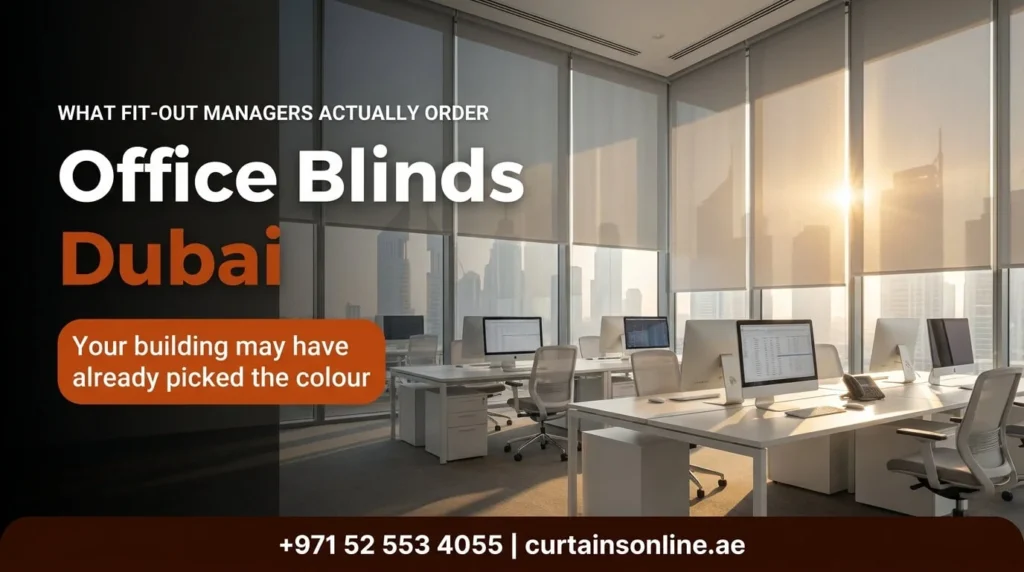
Office roller blinds start at AED 160 per square metre in Dubai, Roman at AED 200, and everything else at AED 270. But the first question on a commercial job is not what it costs. It is what the building will let you install, because in a managed tower the fit-out manual often sets the colour for you.
Working to a window schedule? Send us the drawings and we will quote against them, or send a photo of the specification on WhatsApp.
Free site visit, our own workshop in Al Quoz, no shipping wait. We install seven days a week and can work outside office hours where the building permits it.
Most pages about office blinds in Dubai are written for somebody choosing curtains for a living room. They talk about transforming your workspace and modern elegant designs.
That is not who orders office blinds. The person placing the order is usually a fit-out manager with a programme, a business owner whose rent-free period is ticking, or an office manager whose staff cannot see their screens in the afternoon. None of them is shopping for style. All three are trying not to get something wrong.
So this page is about what actually gets specified, approved and installed.
Key Takeaways
- Roller blinds start at AED 160 per m². Roman AED 200, venetian, vertical and the rest AED 270.
- The building may have chosen your colour already. Fit-out manuals specify it for exterior uniformity.
- Openness factor is a number, and it gets specified. One DIFC manual asks for 3% sunscreen.
- Glare is the real office problem, and blackout is usually the wrong answer to it.
- Fit-out hours are typically 8am to 6pm, Saturday to Thursday, with permits needed in advance.
- Get your building’s fit-out manual before you choose anything. The window covering section is in there.
What Do Dubai Offices Actually Order?
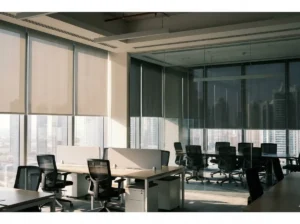
Roller blinds, in most cases. They are the cheapest of the options, they handle screen glare better than anything else, and they sit flat against the glass in a way that suits a modern floor plate. But the right answer changes room by room.
| Space | What it has to do | Usual choice | Why |
| Open-plan floor | Kill screen glare without killing the daylight | Sunscreen roller | A low openness factor cuts glare and keeps the view. Blackout here is a mistake |
| Boardroom | Go dark for a presentation, light the rest of the day | Blackout roller, often with a sunscreen layer | Two jobs, so usually two blinds or a venetian that tilts |
| Reception | Look finished, manage afternoon sun | Venetian or a quality roller | This is the one room where appearance genuinely matters |
| Executive office | Privacy and control | Venetian or motorised roller | Tilting gives privacy without going dark |
| Server or comms room | Block heat and light entirely | Blackout | One of the few places blackout is actually right |
| Meeting pods and glass partitions | Privacy on demand | Vertical or manual roller | Often internal glass rather than external |
The pattern across almost every Dubai office we fit is the same: sunscreen roller on the perimeter, blackout where a screen is used, and something that tilts where somebody senior sits.
The single most common mistake. Ordering blackout for an open-plan floor because people complained about glare. It works for about a week. Then the room is dark, the daylight is gone, staff pull the blinds up, and the glare is back with nothing to show for the money. Glare is an openness factor problem, not a darkness problem.
Your Building May Have Already Chosen the Colour
This is the part that catches people, and it is worth knowing before you show a client a fabric board.
In a managed tower, window coverings are usually covered by the building’s fit-out manual. We read one from a DIFC building recently. On blinds it says the colour must come from the facility design manual, in its words, to ensure uniformity throughout the building. The point is what the tower looks like from outside, not what you want inside.
The same document goes further. Compliance of all window coverings has to follow the relevant authority’s regulations. Nothing may be hung, stuck or attached to the external glazing or its cladding supports. Furniture under a window must not rise above the sill, so the glass can still be replaced and operable panels can still open.
None of that is unusual. Most managed buildings in Dubai have something similar, and the free zones each have their own version. What is unusual is that nobody selling blinds tells you it exists.
Go and find your fit-out manual. It is issued by the building, usually with the fit-out pack, and the window coverings clause is in the technical section. If you cannot find it, ask the facility manager, or send us the building name and we will ask for you. It takes a day and it saves a remake.
What the Fit-Out Manual Will Ask For
Specifications, not preferences. The DIFC manual we looked at is typical in how precise it gets.
| What is specified | The actual wording we found | What it means in practice |
| Colour | From the facility design manual, for uniformity throughout the building | You are matching the building, not choosing |
| Fabric type | Woven, vinyl-coated polyester in a basket weave | Not a domestic fabric |
| Openness factor | 3% for the sunscreen fabric | A number, not a feel. Order 5% and it fails |
| Fabric durability | Dimensionally stable, UV-resistant, resistant to cleaning and to fraying at cut edges | Commercial grade. Cheap fabric frays at the cut edge |
| Roller tube | Galvanised steel or extruded aluminium, with keyways | Not plastic-ended domestic hardware |
| Serviceability | Easily removable from its brackets | Maintenance over a lease, not a one-time install |
| Operation | Manually or electrically operated | Motorised is allowed, but check the power provision |
Read that list and you can see why a cheap supplier struggles on a commercial job. Half of those clauses are about what happens three years into a lease, not what the blind looks like on day one.
Two of them are worth saying plainly. A domestic roller tube with plastic ends will not pass a serious inspection. And fraying at cut edges is the thing that gives away a fabric that was never made for commercial use, usually about eight months in.
Why Openness Factor Decides Your Office, Not Darkness
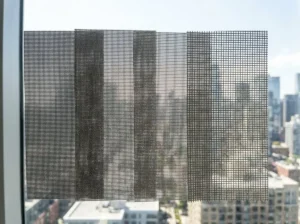
If you take one technical thing from this page, take this one.
Openness factor is the percentage of a woven fabric that is open weave rather than yarn. It controls two things at once, and they pull against each other: how much glare comes through, and how much you can see out.
| Openness | Glare control | View out | Where it fits |
| 1% | Strongest | Very limited | Screens facing west, severe afternoon glare |
| 3% | Strong | Usable, softened | The common office specification |
| 5% | Moderate | Good | Where the view matters and glare is mild |
| 10% | Weak | Clear | Rarely right for a working office |
| Blackout, 0% | Total | None | Presentation rooms, server rooms |
The building we quoted from specifies 3%, and that is the figure we see most often in Dubai office specifications. It is the balance point: enough to make screens usable in the afternoon, not so much that the floor feels closed in.
The orientation of the glass matters as much as the number. A west-facing floor takes direct sun from mid-afternoon until past seven in summer, and a 5% fabric that works on a north elevation will not cope on a west one. If a floor has glass on two elevations, it is normal to specify different fabrics on each.
Not sure what your manual asks for? Send us the window covering clause or a photo of it on WhatsApp. We will tell you what fabric meets it and what it will cost, before you commit to anything.
What Do Office Blinds Cost in Dubai?
Here is where we start, per square metre:
| Type | From (AED per m²) | Where it is usually used |
| Roller blind | 160 | Open-plan floors, most of a typical office |
| Roman blind | 200 | Reception and executive offices where a softer look is wanted |
| Venetian, vertical, honeycomb and others | 270 | Boardrooms, executive offices, wide internal glass |
| Motorised | Quoted on the job | Depends on the power provision and the control system |
Worth being straight about one thing. Our own office blinds product page leads with the AED 270 rate, which is the figure for venetian, vertical and the rest. Most offices order roller, and roller starts at AED 160. If you are budgeting a floor, use the lower number as your starting point and let the specification move it from there.
What moves the number: the fabric and its openness factor, the drop, whether the blind is cassetted, whether anything is motorised, and how many separate blinds a wide glass run needs. That last one surprises people, because a continuous glass wall cannot take one enormous blind and the joins have to be planned.
You will see Dubai suppliers advertising from much lower per-square-metre figures. Those are entry fabrics on a domestic specification, and on a commercial job with a fit-out manual they usually will not meet the fabric clause. It is worth checking what fabric a low quote is actually built on before comparing it with anything else. Our guide on what blinds cost in Dubai sets out the residential picture for comparison.
For a real figure rather than a range, send the window schedule. A floor plan with dimensions gets you a quote you can put in a tender.
Approvals, Permits and When We Can Actually Install
This is the part that moves a programme, and it is the part most quotes ignore completely.
In a managed building, blinds normally sit inside the fit-out approval rather than outside it. The sequence is broadly the same across the free zones: you get the fit-out pack from the building, appoint an accredited contractor, submit the design to the facility manager, collect the approved drawings and the no-objection certificate, then obtain the authority approvals that apply to your zone.
Three details from the manual we read that have programme consequences:
- A permit to work has to be submitted in advance, in that building at least 48 hours before anything starts. No work proceeds while it is pending, which means a blind delivery that arrives before the permit does simply sits there.
- Fit-out working hours were 8am to 6pm, Saturday to Thursday. Anything outside that needed written approval from the facility manager, and night works needed a separate permit from the authority. If the office is occupied, plan for this at the start.
- The contractor has to hold the right accreditation to be on site at all. This is the clause that quietly rules out most of the cheapest quotes, and it is worth asking about before a price comparison, not after.
None of this is difficult. It is just sequential, and the sequence is what people underestimate. Dubizzle publishes a useful plain-language overview of the wider fit-out approval process if you want the full picture, and it is linked at the end of this page.
Every building is different. The figures on this page come from one real Dubai fit-out manual, not from yours. DMCC, DIFC, JAFZA, Business Bay and the rest each have their own, and so does almost every individually managed tower. Get your own and read the window covering clause. If it is not clear, we will read it with you.
One Window or a Whole Floor?
They are different jobs, and the difference is not just quantity.
A single office or meeting room is straightforward. We measure, make and fit, usually within the week, and we make in our own workshop in Al Quoz so nothing is waiting on a shipment.
A whole floor brings in things a single room never does. Wide glass runs have to be split into multiple blinds, and where the joins fall is a decision somebody has to make rather than something that happens by accident. Different elevations may need different fabrics. The install has to be sequenced around whatever else is happening on site, and if the floor is occupied it may have to happen out of hours across several evenings.
There is also the question nobody asks at quote stage and everybody asks in year three: what happens when one blind fails. This is why the manual asked for tubes that are easily removable from their brackets, and it is why it is worth knowing whether your fabric will still be available in two years. On a five-year lease, one replaced blind in a visibly different colour is a real problem.
If you are working from a window schedule, send it. A list of openings with dimensions and elevations gets you a quote, a sequence and a date.
How to Order Office Blinds in Dubai
- Get the building’s fit-out manual first and find the window covering clause. Colour, fabric type and openness factor are usually specified there, and everything else follows from it.
- Work out what each space has to do. Glare on the open-plan floor, darkness in the boardroom, privacy where somebody senior sits. Different answers, same floor.
- [Send us the drawings or the window schedule](https://curtainsonline.ae/contact-us/) or a photo of the specification on WhatsApp. We quote against a schedule, not a product list.
- Tell us the programme and whether the floor is occupied. This decides whether we are installing in working hours or out of them, and it affects the permit.
- Confirm the fabric against the clause before anything is cut. A blind in the wrong colour or the wrong openness factor is a remake, and remakes cost weeks, not days.
- We make in Al Quoz and install. Our own workshop, no shipping wait, and we can sequence a floor across several visits where the site needs it.
If you are a fit-out contractor rather than an end client, most of our commercial work comes that way. Send the schedule, the programme and the landlord specification and we will quote against all three.
Frequently Asked Questions
How much do office blinds cost in Dubai?
Roller blinds start at AED 160 per square metre, Roman at AED 200, and venetian, vertical, honeycomb and the rest at AED 270. Roller is where most offices land, because it is the cheapest of those and the one that handles screen glare best. The final figure depends on the fabric, the openness factor, the drop and whether anything is motorised, so a floor plan or a window schedule gets you a real number rather than a range.
Can I choose the colour of my office blinds in Dubai?
Often not, and this surprises people. In a managed tower the fit-out manual usually specifies the blind colour so the building looks uniform from outside. One DIFC building’s manual states the colour must come from the facility design manual to ensure uniformity throughout the building. Check your own manual before you choose anything, because a blind made in the wrong colour is a remake, not an adjustment.
What is an openness factor and why does it matter in an office?
It is the percentage of the fabric that is open weave, and it decides how much you can see out and how much glare gets through. A lower number means less glare and less view. One Dubai landlord’s fit-out manual specifies a 3% openness sunscreen fabric for its office floors. If a manual gives you a number, that is a specification rather than a preference, and ordering 5% where 3% was asked for is a failed inspection.
What blinds are best for an office with computer screens?
Sunscreen roller blinds, not blackout. Glare is the complaint in almost every open-plan office, and the instinct is to order something that blocks everything. That removes the daylight and the view, and staff end up pulling the blinds back up, so you have paid for nothing. A sunscreen fabric at a low openness factor cuts the glare while keeping the room usable.
Do you need approval to install blinds in a Dubai office?
In a managed building, usually yes. Window coverings normally fall under the fit-out approval, which goes through the facility manager and, depending on the free zone, the relevant authority. Work usually needs a permit to work submitted in advance, and contractors generally need the right accreditation to be on site at all.
Can you install office blinds outside working hours?
Usually yes, but it has to be arranged rather than assumed. The building we looked at sets fit-out working hours at 8am to 6pm, Saturday to Thursday, with written approval needed for anything outside that, and night works needing a separate permit. If your office is occupied, plan for out-of-hours installation at the start rather than discovering the restriction the week before.
How long do office blinds take for a whole floor?
Longer than for one window, and the honest answer depends on the fabric. We make in our own workshop in Al Quoz, so there is no shipping wait, but a full floor is a different job from a single room. Send the window schedule or the floor plan and you get a date rather than an estimate.
What blinds go in a boardroom?
Usually two layers, or a blind that can do two jobs. A boardroom needs enough darkness for a screen presentation and enough light for the rest of the day, so a blackout roller for presentations alongside a sunscreen for ordinary use is common. Venetian blinds also work where the room wants a more finished look and the light needs tilting rather than blocking.
Do you supply blinds for a fit-out contractor rather than an end client?
Yes, and most of our commercial work comes that way. If you are working to a window schedule, a programme and a landlord specification, send those and we will quote against them rather than against a product list.
Send Us Your Window Schedule
Roller from AED 160 per m², and a quote you can put in a tender. Send us the drawings or a photo of your fit-out manual’s window covering clause on WhatsApp. You can also see the range on our office blinds page.