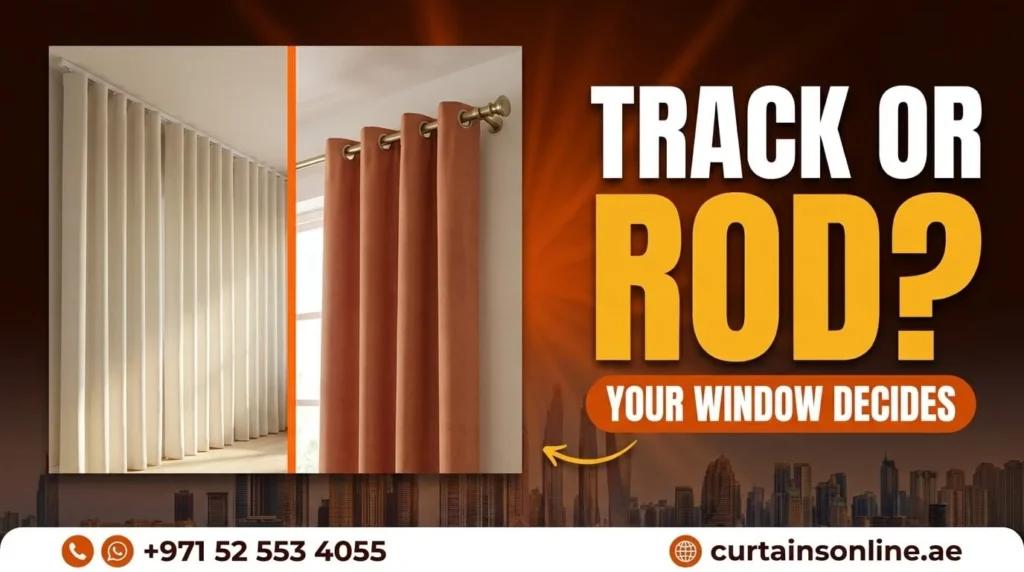
In most Dubai apartments the window decides this, not you. If the glass runs to the ceiling there is no wall above it to hold rod brackets, so it has to be a ceiling track. Where you do have a choice, the heading decides: wave and motorised need a track, eyelet needs a rod.
Not sure what your window will take? Book a free measurement or send a photo on WhatsApp. We will tell you before anything is ordered.
Most people pick the curtain first and think about what holds it up afterwards. In Dubai that order gets you into trouble, because a lot of windows here only accept one answer.
This page goes through it the other way round: what your window allows, then what the style you want actually needs, and when a rod is still the better call.
Key Takeaways
- Floor-to-ceiling glass means a ceiling track. There is no wall above the window for brackets.
- Wave and motorised curtains need a track. Eyelet needs a rod. Pinch pleat works on either.
- Wide runs and heavy lined fabric belong on a track, because a rod carries its load at two or three points.
- A rod is a design choice, and a good one when you want the hardware seen.
- Changing later usually means changing the curtains too, because the heading is sewn in.
Track or Rod? In Most Dubai Apartments the Window Decides
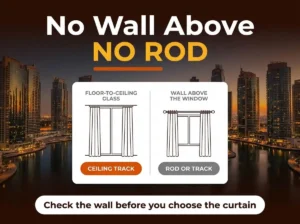
Before style comes into it, look at the wall above your window.
Standard advice says to mount the hardware 12 to 15cm above the frame. That assumes there is wall there. In a Marina, JLT or Business Bay tower there often is not, because the glazing runs from the floor to the ceiling. With nothing above the window to screw into, a wall-mounted rod has nowhere to go, and the answer becomes a ceiling-fixed track.
Three other things we run into often enough to mention:
- A gypsum pelmet or curtain pocket. Plenty of Dubai apartments have a recess built into the false ceiling along the window wall. A track sits inside it and disappears. A rod cannot, because the brackets need to stand clear.
- An AC bulkhead. A boxed-out section of ceiling running along the window is common here, and it changes where the fixing can go and sometimes which system is possible at all.
- A curved or angled window. A track can be bent to follow the shape. A pole is rigid, so it has to be broken into separate sections with brackets at each joint.
Worth knowing before you order: the fixing surface matters as much as the window. A concrete slab, a gypsum false ceiling and a timber bulkhead all need different anchors, and that is decided on site rather than from a photo.
Which Curtain Styles Need a Track?
Once the window allows both, the heading decides. The heading is the top of the curtain, and it is sewn in, so this is not a detail you can change your mind about afterwards.
| Style | Needs | Why |
| Eyelet | Rod only | Metal rings are set into the fabric and thread onto the pole |
| Wave (S-fold) | Track only | Hangs from glides at fixed spacing, which is what makes the S shape |
| Motorised | Track only | The motor drives a carrier along a track |
| Pinch pleat | Either | Hooks into track glides, or onto rings on a rod |
| Pencil pleat | Either | Same, hooks take it to a track or a rod |
| Sheer | Either | Usually a track when layered behind blackout on a double system |
That table is the quiet reason most of our villa work ends up on track. Wave curtains are the most requested style we fit, and they are a track-only product. The same goes for motorised curtains, where the motor has to run along something.
If you are still choosing a style rather than hardware, curtain types explained goes through the headings and how each one hangs.
When a Rod Is the Better Choice
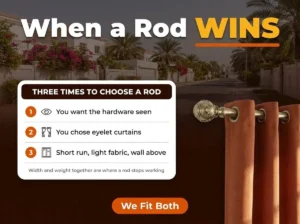
A track is not automatically the right answer, and we fit plenty of rods.
Use a rod when you want the hardware to be seen. A good pole in brushed brass or matt black is part of the room. A track is designed to disappear, which is right in a modern apartment and wrong in a room built around warm materials and visible detail.
Use a rod for eyelet curtains, which is the look a lot of people actually want. The deep even folds of an eyelet heading come from the rings sliding on a pole.
Use a rod for a normal single window where the run is short, the fabric is not heavy and there is wall above the frame to fix into. On a window like that a track buys you nothing.
Where a rod stops working is width and weight together. A pole carries its whole load at two or three brackets. Put a wide run of lined blackout on it and the middle sags, which you see every time the curtains are closed. A track carries the same weight spread across every glide along its length.
What Our Installers See in Dubai Homes
A few patterns come up again and again on measurement visits.
- Apartment, floor-to-ceiling glass: ceiling track, nearly every time. Often a double track so sheer and blackout can layer on the same window.
- Villa, normal windows with wall above: a genuine choice. Rod if the room is traditional, track if the client wants wave.
- Bedroom in an older building: rod is usually fine, and cheaper to fit.
- Office or clinic: track, because the runs are long and the curtains get used hard.
The one that catches people out is the apartment where the living room glass goes to the ceiling but the bedroom window has a normal wall above it. Same flat, two different answers, and you only notice when somebody measures.
Does the Hardware Change What You Pay?
Less than people expect.
On a made-to-measure order the fabric and the width drive the price, not the pole or the track. The bigger difference comes from the heading you picked, because some headings use more fabric than others. Wave starts at AED 180 per m², eyelet at AED 150, and pinch pleat at AED 110, so the style you choose moves the number more than the hardware does.
Motorised is the exception. At AED 340 per m² it is our most expensive option, and there the system genuinely is a large part of what you are paying for. Our full breakdown of how much curtains cost in Dubai has the rest of the range.
One thing worth budgeting for: a track that has to be bent to follow a curve or a bay is made to shape, so it takes longer and costs more than a straight run of the same length.
Can You Switch From a Rod to a Track Later?

Usually yes, but the curtains often have to change with it, and that is the part people do not expect.
The heading is sewn into the fabric. Pinch pleat and pencil pleat attach with hooks, so they move between a rod and a track without much trouble. Eyelet cannot move at all, because the rings are part of the curtain. Switching to a track means a new heading on the same fabric, or new curtains.
We alter headings regularly, so it is often a tailoring job rather than a fresh order. Either way, it is cheaper to get the decision right the first time, which is what the free measurement visit is for. Our installation service page covers how the fitting works.
Working out sizes before you decide? Read how to measure for curtains in Dubai, which covers track width, drop and fullness.
Frequently Asked Questions
Is a curtain track better than a rod?
Neither is better on its own. A track is better for wide runs, heavy curtains, bay or curved windows, floor-to-ceiling glass and anything motorised. A rod is better when you want the hardware to be visible as part of the room, and it suits eyelet curtains, which thread straight onto the pole.
Can you put eyelet curtains on a track?
No. Eyelet curtains have rings sewn into the fabric that slide along a pole, so they need a rod. If you have already chosen a track, the heading has to change to pinch pleat, pencil pleat or wave.
Do wave curtains need a track?
Yes. Wave, also called S-fold, hangs from glides spaced along a track, and that spacing is what creates the even S shape. There is no rod version of a wave curtain.
What do you use for floor-to-ceiling windows in Dubai apartments?
A ceiling-fixed track, almost always. In a tower apartment the glass usually runs to the ceiling, so there is no wall above the window to take rod brackets. The track goes onto the ceiling slab or into the gypsum above it.
Can a curtain rod hold blackout curtains?
For a normal bedroom window, yes. On a wide run it becomes a problem, because a rod carries its weight at two or three brackets and heavy lined fabric makes it sag in the middle. A track spreads the load across every glide instead.
Can I change from a rod to a track later?
Yes, but the curtains usually have to change with it, because the heading is sewn in. Eyelet curtains cannot move to a track. Pinch pleat and pencil pleat can, since they attach with hooks. We can often alter the heading rather than remake the curtain.
Does a track cost more than a rod?
The hardware itself is not where the money is. On a made-to-measure order the fabric and the width drive the price far more than the track or pole does. The bigger cost difference comes from the heading you choose, because wave uses more fabric than eyelet.
Let Us Look at the Window First
Send a photo of your window and we will tell you what it will take, before you choose a fabric. Book a free measurement or message us on WhatsApp. We measure, we fit, and nothing is ordered until the hardware is settled.