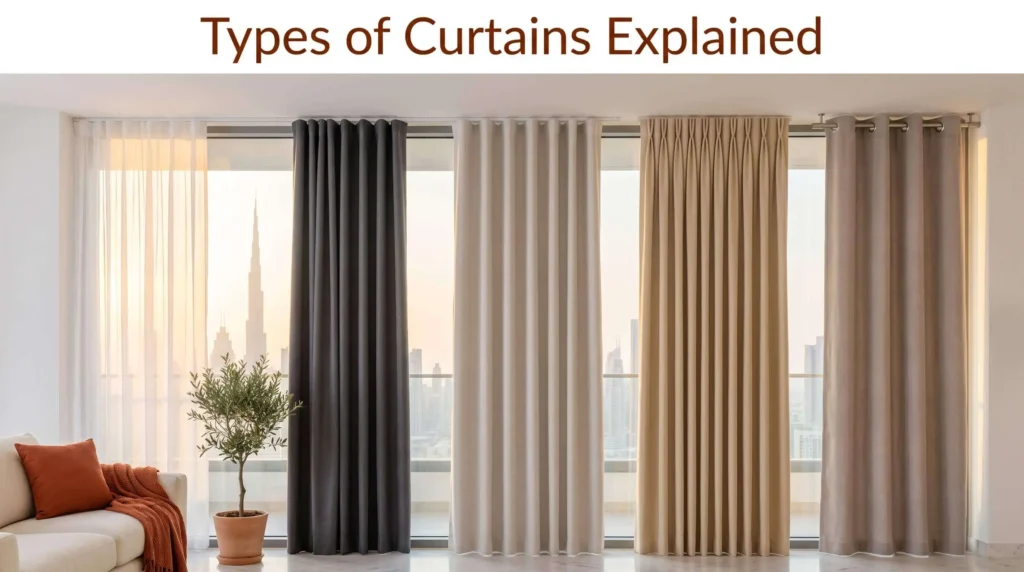
When it comes to curtains, there’s more to it than just selecting the fabric for your interior. Fabric as well as heading are the two factors that impact the curtain. The types of curtains explained in this blog will help you to make an informed decision. You can then select the curtains that best fit your room, window size, and daily requirements.
Sheer, blackout, wave, pinch pleat together with eyelet curtains are explained in this guide, detailing their differences, advantages, as well as best use.
Different Types of Curtains Explained
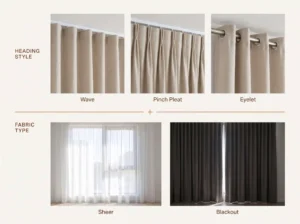
Curtains can be classified based on the type of fabric or the type of heading. Sheer and blackout are used to describe the effect the curtain has on light, while wave, pinch pleat and eyelet are used to describe the way the fabric is arranged at the top.
These features are all optional and can be used together. For instance, blackout material can be made with a wave heading and sheer fabric can be finished with eyelets. This difference is important to know when making a selection of curtains.
Sheer Curtains: Soft Natural Light
Sheer curtains are made with a light as well as translucent material that lets light in. They diffuse direct sunlight and at the same time they provide a sense of openness. This makes them ideal for living rooms, combined with dining areas and rooms where natural light is important.
What Are Sheer Curtains?
Sheer curtains are window coverings that are transparent or semi-transparent. The difference between sheer vs voile is that sheer is a curtain that lets a certain amount of light in and voile is a type of fabric.
Best for: Living rooms, dining areas and multiple window coverings.
Consider: Sheers offer little privacy at night with lights on. Use blackout curtains in bedrooms or rooms facing the street for extra coverage.
Blackout Curtains: More Light Control
Blackout curtains are made from dense fabric, backed by special construction or blackout lining to prevent a significant amount of light from entering. They can be helpful when sunlight disrupts sleep and television viewing or daytime sleep.
They can be especially useful in bedrooms that are facing a lot of sunlight in Dubai. Blackout curtains can also help minimize heat transfer through windows. But it also depends on how they are made as well as installed.
Best for: Bedrooms, together with nurseries plus media rooms.
Consider: Light can still get through the sides of a curtain. These gaps can be minimized with wider coverage along with the right tracks. You can also combine blackout curtains with sheer panels to enjoy filtered daylight during the day.
Wave Curtains: Smooth, Continuous Folds
Wave curtains produce uniform S shaped waves throughout the curtain. They are not made with stitched pleats. But with a compatible track system that has gliders with a special spacing.
What is Wave Curtains Style?
Wave curtains (also called ripple fold curtains) give a flowing effect when open or closed. They are a good selection for wide windows, along with sliding doors and floor to ceiling glazing. Particularly in modern interiors.
Best for: High ceilings together with modern apartments and large windows.
Consider: Wave curtains require compatible hardware and the right fabric fullness. Track spacing, as well as fabric weight and installation, all affect the final appearance.
Pinch Pleat Curtains: A Tailored Appearance
Pinch pleat curtains are those that have been stitched up in groups at the top. This provides a neat and finished look, whereas wave curtains create continuous folds.
Double pinch pleats are commonly two pleats grouped together and triple pinch pleats form a fuller and more decorative heading. The proper hanging system will vary depending on the type of heading construction.
Best for: Formal living rooms; combine with dining rooms and interior spaces that require a refined look.
Consider: Pinch pleats need to be carefully measured and sufficiently sized in fabric to keep the pleats in place. They might need extra space at the sides when opened as well.
The difference between pleat styles are primarily in the shape, spacing and fullness of the pleats. Pinch pleats form groups of folds and wave headings form a continuous pattern.
Eyelet Curtains: Relaxed, Rounded Folds
The eyelet curtains have rings that will be attached directly to the fabric at the top end. The rings will slot onto the curtain pole to create smooth folds without using the conventional hooks and headings.
These will be quite user-friendly once set up properly. Eyelet headings will work well with other fabrics like sheers and blackout materials.
Best for: Bedrooms, together with casual lounges as well as trendy interiors.
Consider: Eyelet curtains will require a special curtain pole as compared to the ordinary ceiling track. Please measure the size of the ring before purchase.
Curtain Header Types: How Do They Compare?
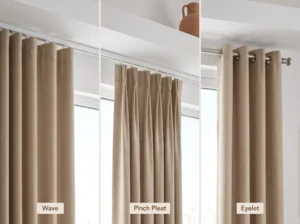
Knowing the primary types of curtain headings will enable you to choose the correct finish and hardware.
| Curtain type | Appearance | Main purpose |
| Sheer | Light, translucent fabric | Filter daylight |
| Blackout | Heavy or patterned fabric | Block out light from entering the room |
| Wave | Continuous S-shaped folds | Create a flowing finish |
| Pinch pleat | Structured stitched folds | Achieve a customized look |
| Eyelet | Rounded folds on a pole | Provide a relaxed finish |
Keep in mind that sheer and blackout refer to the performance of the fabric. Wave, along with pinch pleat and eyelet, describes the style of the heading. This allows you to use light filtering or blackout fabric in combination with a suitable heading design.
Which Curtain Type Should You Choose?
First, think about what you want out of your window covering. Sheers are suitable for a softer light and blackout curtains for rooms that require a darker light.
Then select the look you want. Wave curtains work best with wide windows that have continuous folds. Pinch pleats give a custom look and eyelets give a casual appearance.
The size of the windows and the hardware you already have also play a role. At CurtainsOnline, we can help you find the right fabric and heading combination for your space with our made to measure options.
Final Thoughts
The types of curtains explained give you a good idea for picking the right curtain for your space. But it will also depend on the privacy you require as well as the look you want. The amount of daylight you want in your room is also a critical factor. First, compare the function of the fabric and then get a heading that matches your interior and window configuration.
CurtainsOnline has made to measure curtains for various windows and interior designs. These factors can help you make informed decisions when buying curtains for your home.
Frequently Asked Questions
What are the main types of curtains?
Sheer, blackout, wave, pinch pleat and eyelet are popular options. They vary in the amount of light they allow to pass through, their fabric arrangement and the overall appearance.
What is the difference between sheer and blackout curtains?
Sheer curtains let in light through a light fabric. Blackout curtains block a lot more light.
Is a special track required for wave curtains?
Yes, it is true that wave curtains require a track that is compatible with the gliders and has the right spacing between gliders to keep the curtains in continuous folds.
Do pinch pleat curtains work better than eyelet curtains?
Neither is necessarily superior. Pinch pleats give a formal look and eyelet curtains give rounded folds on a curtain pole.
Do sheer curtains provide privacy at night?
Sheers provide little privacy at night when the lights are inside. Blackout curtains can be used to cover them for extra protection.
Are blackout curtains available in various styles of heading?
Yes, when the fabric construction and hardware are appropriate, blackout fabric can be made with wave, pinch pleat or eyelet headings.