
Curtains can last for years when the fabric, stitching plus hardware are properly maintained. But daily use can eventually lead to loose seams, alongside broken hooks, damaged hems and problems with the track. Sun exposure, dust, together with frequent movement, can also speed up wear.
The good news is that many curtain repair problems do not require complete replacement. Small tears, along with loose stitching and damaged hooks can mostly be fixed. But some curtains reach a point where replacing them makes more sense.
This blog explains the most common curtain problems. What can be repaired and when to replace curtains instead.
What Are the Most Common Curtain Repair Problems?
Curtain damage does not always start with the fabric itself. Sometimes the problem comes from the stitching, along with heading tape, hooks and hardware supporting the curtain.
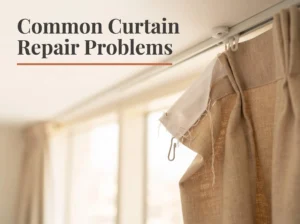
Below are some of the issues commonly faced by people:
Torn or Damaged Fabric
Small tears can commonly be repaired through careful stitching plus patching. The repair method depends on the fabric. Also, on the location as well as the size of the damage.
In case of big tears, large wear followed by very weak fabric, then restoration may become difficult. Therefore, it is advisable to replace the damaged panel.
Curtain Seam Coming Apart
A curtain seam coming apart is usually repairable when the surrounding fabric remains strong. Loose stitching can be removed and resewn with suitable thread.
This happens more commonly at places such as side seams. Where there is tension on them. It would be best to mend the tear while it’s still small.
Broken Curtain Hooks
Curtain hooks broken or detached from the heading can make panels hang unevenly. Fortunately, individual hooks are usually simple to replace.
If several hooks have pulled away because the heading tape has weakened, replacing the hooks alone may not solve the issue. The tape or curtain heading may need attention as well.
Loose or Damaged Curtain Tape
Heading tape controls how curtains gather and hang. When it loosens, the curtain may stop forming its original folds or become uneven across the top.
If you are wondering how to fix curtain tape. Avoid simply pulling or tying the loose section tighter. The damaged tape may need to be carefully restitched or replaced so the curtain hangs correctly.
Worn Curtain Hems
Curtain hems can loosen from repeated contact with floors, cleaning or movement. A professional curtain hem repair can restore the bottom edge without replacing the entire panel.
Shortening the curtain at the same time may also be worthwhile. If the original length no longer suits the room.
Can Curtain Tracks and Rods Be Repaired?
Not every curtain problem involves fabric. Tracks and rods can also develop issues after prolonged use.
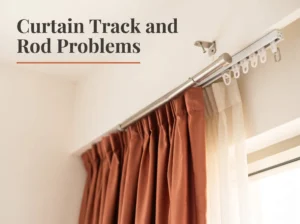
Common hardware problems include:
- Loose brackets
- Bent rods
- Jammed runners
- Misaligned tracks
- Damaged end stops
- Worn gliders
- Loose wall fittings
If the bracket is slightly loose or if there is a slight alignment problem. It may just need to be adjusted. If the rod is damaged or the track is too bent. It will need to be replaced.
The hardware for heavy curtains must also be appropriate for the weight of the curtains and the construction of the wall. Rod pulling away from the wall can result from using improper anchors or support.
When Does Curtain Track Repair Make Sense?
Curtain track repair is worth considering when the track itself remains structurally sound. But has a functional problem.
For example, worn gliders, loose fittings plus minor alignment issues may be repairable. Dust can also affect the movement of some tracks over time.
If the track is badly damaged, bent or no longer suitable for the curtain weight. Replacing the system may provide a more reliable solution.
How Do You Know If a Curtain Can Be Repaired?
A simple inspection can help you decide.
Repair Is Usually Suitable When:
- The fabric is still strong
- Damage is limited to one area
- Seams are loose but not extensively torn
- Hooks or rings are damaged individually
- The hem has come undone
- Heading tape is loose
- The track has a minor mechanical issue
- The curtain still suits the room
If the main fabric remains in good condition, repairing a specific fault can extend the curtain’s usable life. Competitor repair services also commonly recommend repairs for minor tears, loose seams, detached hooks and treatable hardware issues.
When Should You Replace Curtains Instead?
Repair is not always the right answer. Some curtains become too worn for a neat or worthwhile restoration.
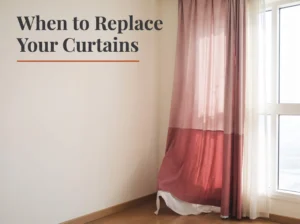
Extensive Fabric Damage
If large areas are torn, badly frayed or structurally weak, stitching may only provide a temporary solution.
Severe Fading
Strong sunlight can gradually fade curtain fabric. When fading is widespread, a small repair will not restore the original appearance.
Repeated Repairs
If the same curtain needs frequent stitching, hook replacement and hem repairs, the fabric may simply be reaching the end of its useful life.
Poor Fit
Sometimes the curtain is still in good condition. But it no longer fits the window properly. Moving home. Changing the window treatment or altering the room layout can make the original dimensions unsuitable.
Outdated Style
A curtain can be perfectly functional while no longer matching the interior. If you already need major alterations, replacement may be a better opportunity to update the room.
Damaged Lining
A deteriorated lining can affect the curtain’s structure, appearance and performance. In some cases, the lining can be replaced. If both the lining and outer fabric are worn, replacement may be more sensible.
Curtain Repair vs Replacement: What Should You Choose?
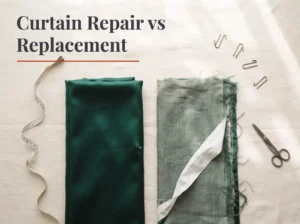
The decision should be based on the condition of the whole curtain, not just the visible damage.
| Problem | Repair | Replace |
| Small tear | Mostly suitable | Rarely needed |
| Loose seam | Suitable | Not normally required |
| Broken hooks | Usually suitable | Only if heading is damaged |
| Loose curtain tape | Mostly suitable | If tape and fabric are badly worn |
| Damaged hem | Mostly suitable | If fabric is deteriorated |
| Minor track issue | Often suitable | If track is structurally damaged |
| Severe fading | Limited benefit | Usually more practical |
| Large fabric tears | Depends on extent | Often necessary |
| Repeated repairs | May become uneconomical | Worth considering |
| Completely outdated or unsuitable curtains | Possible alteration | Replacement may be preferable |
The aim is not to repair every curtain at any cost. It is to determine whether the existing fabric and construction are worth restoring.
Can You Repair Curtains Yourself?
Some small repairs can be handled at home. Replacing an individual hook, for example, is relatively straightforward when the heading remains intact.
Simple hand stitching may also work for a small loose seam. However, visible repairs on delicate, lined or patterned fabrics can become noticeable if the thread, tension or stitch does not match correctly.
Hardware requires more care. A loose rod bracket should not simply be glued back into place. Because it needs to support the weight of the curtain. Damaged or load bearing hardware should be properly secured and replaced.
Motorized curtains are another case where professional assistance is preferable. Faults involving motors, wiring, controls or sensors require more than a basic fabric repair.
How Can You Prevent Common Curtain Damage?
Regular care can reduce many curtain repair problems before they become expensive.
Keep curtains moving freely instead of pulling them sharply. Check hooks and heading tape occasionally, especially on frequently used panels.
Dust can also collect around tracks and affect curtain movement. Maintaining a clean track area helps to avoid unnecessary strain on runners and gliders.
If curtains are placed in strong sunlight, they can be protected by using suitable lining and appropriate cleaning. Use the care instructions provided for the particular material, not a general cleaning method.
Tackle seams that begin to open or loose hooks early. Small fabric damage is easier to manage than big fabric damage.
A Simple Rule for Deciding Between Repair and Replacement
Consider three factors: condition of the fabric, level of damage and overall suitability.
When the fabric is strong, and the problem is confined to a small area, it is generally advisable to repair. Replacement may be a better lasting solution if the material is faded, brittle or heavily damaged.
Take into account the existing fit of the curtain. If the curtain still fits the window and is appropriate for the room, it’s a repair. When its size, style or function is no longer appropriate, it may be a solution to several problems.
The right choice is therefore not simply about the repair cost. It is about how much useful life remains in the curtain.
Final Thoughts
Not every damaged curtain needs to be replaced straight away. Small issues like loose seams, broken hooks, damaged hems, along with curtain tape can mostly be repaired with the right plan.
Regular care can also help prevent minor damage from becoming more serious issues. However, heavily faded, weakened, as well as repeatedly damaged curtains may be better replaced. A careful look at the fabric, stitching together with hardware can help you decide whether repair or replacement makes more sense.
FAQs
Can torn curtains be repaired?
Yes, tears and seams may be sewn back or patched. Fraying edges can also be fixed. But sometimes the whole panel may have to be changed due to extensive damage.
How do I fix curtain tape?
Torn or unattached heading tape has to be repaired by means of proper stitching or replacement. In case of wear out of the whole heading tape, it might be better to replace the whole damaged section.
What can I do if my curtain hooks are broken?
Broken hooks can be easily replaced, while in case of wear out of the whole heading tape, it has to be mended before installation of new hooks.
Can I repair a curtain track?
Small damages to a curtain track (alignment problems, bent runners or damaged fittings) can be fixed. However, in case of severe damages, the track will have to be replaced.
When should I change curtains instead of repairing them?
One can consider changing curtains in case of extensively damaged fabric, poor quality of fabrics due to fading or repeated damages and unsuitability for certain windows.