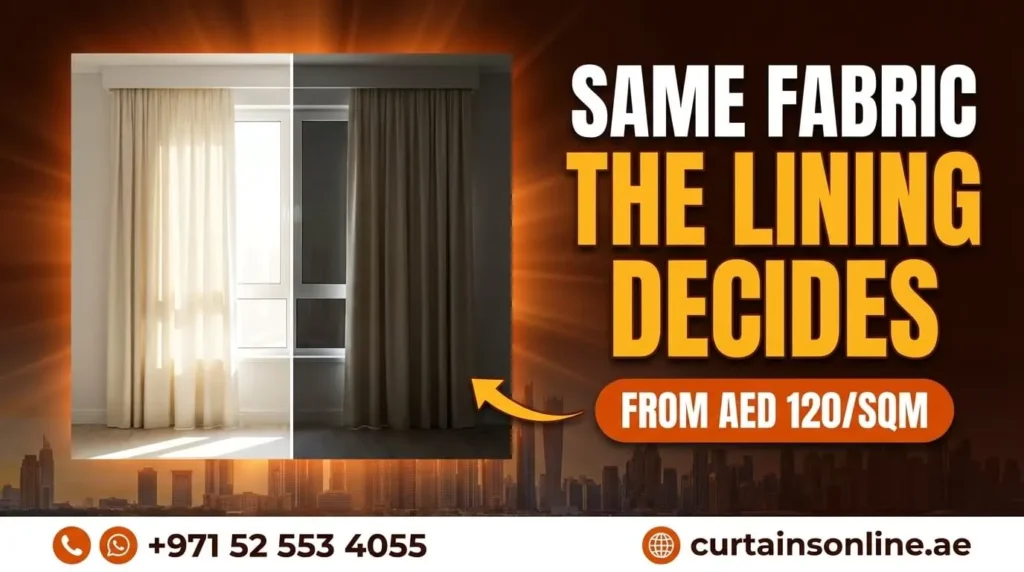
The percentage on a blackout curtain tells you less than you think. Dubai suppliers publish 95, 99 and 100 percent, sometimes all three on the same page, with no test method behind any of them. What actually decides how dark your room gets is the lining, and there are four to choose from.
Want a number for your window? See our blackout curtains from AED 120/m², or book a free measurement and we will come and look at the room.
Spend ten minutes comparing blackout curtains in Dubai and you will notice something odd. One page says 99 percent. Another says 95 to 99. A third says 100 percent, and then two paragraphs later admits light comes in around the edges.
They are not all lying. They are quoting numbers that were never measured the same way, for a thing that was never defined. This page explains what the figure actually describes, what decides darkness instead, and how to work out which grade you need rather than paying for the top one by default.
Key Takeaways
- The percentage is not standardised. Suppliers publish it without saying how it was tested, so you cannot compare two quotes on it.
- The lining decides, not the face fabric. Four linings, four different results.
- Heavier does not mean darker. Foam-backed is the bulkiest and blocks the least.
- Foam-backed is a poor choice in coastal Dubai, because the foam degrades in heat and humidity.
- A liner can usually be added to curtains you already own, which saves a full reorder.
What Does 99% Blackout Actually Mean?
Less than it sounds, and here is the honest version.
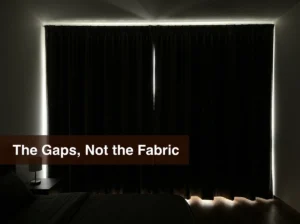
That figure describes light passing through the cloth. It says nothing about the light coming around the sides of the curtain, over the top of the track, or under the hem. Those are the gaps most people are actually complaining about when they say their blackout curtains do not work.
The second problem is that the numbers are published without a test behind them. There is no shared method being quoted, so one supplier’s 99 percent and another’s 95 percent are not measurements you can line up against each other. They are closer to descriptions than to data.
A fair way to read any blackout claim: treat it as a rough band, not a figure. Anything described as blackout will stop the great majority of light through the fabric. The difference between brands is mostly in the lining, the weight and how it hangs, not in the last percentage point.
So the useful question is not “how many percent”. It is “which lining, and is the room set up to use it”.
Fabric or Lining? They Are Not the Same Thing
This is the distinction almost nobody explains, and it changes what you shop for.
A blackout fabric is woven or coated so that light cannot pass through it. The darkness is in the cloth itself, which means the cloth is usually dark, heavy, or both.
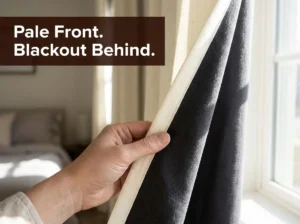
A blackout-lined curtain is a normal face fabric with a second layer behind it that does the blocking. The front of the curtain can be linen, cotton, velvet, anything, in any colour, because the lining is doing the work out of sight.
Most made-to-measure orders in Dubai are the second kind, and that matters for one practical reason: the colour you choose has almost nothing to do with how dark the room gets. People talk themselves into charcoal curtains they do not want because they assume pale fabric cannot be blackout. It can.
If you are still deciding on the look rather than the performance, curtain types explained covers the headings and how each one hangs.
The Four Linings, and What Each One Is For
This is the decision. Everything above was leading here.
| Lining | How dark | Weight and drape | Washing | Best for |
| Triple-weave | 98%+ | Heavier, but still drapes softly | Machine washable, cold and gentle | The default for bedrooms |
| Coated | 95 to 99% | Stiffer, can rustle when moved | Spot clean only, coating can crack | Budget jobs and short-term rentals |
| Foam-backed | 90 to 95% | Bulkiest, drapes worst | Degrades in heat and humidity | Insulation first, darkness second |
| Detachable liner | Depends on the liner | Adds weight to the existing curtain | Comes off, so the easiest to wash | Curtains you already own |
| Interlined | Varies | Heaviest, best insulation and sound | Dry clean | Villas and formal rooms |
Two things in that table surprise people.
Heavier does not mean darker. Foam-backed is the bulkiest option and blocks the least light of the three built-in linings. If you choose it expecting the darkest room, you have paid for weight you did not want.
Foam-backed is the one to think hard about in Dubai. The foam degrades with heat and humidity, which is a reasonable trade in a dry climate and a poor one in a coastal apartment in August. In Marina, JBR or on the Palm, triple-weave is the safer choice and it drapes better anyway.
Lining also changes how the curtain is cleaned, and that catches people out later. Our guide on how to wash blackout curtains explains why a bonded lining and a face fabric do not always survive the same wash.
How Dark Do You Actually Need?
Worth asking, because the top grade costs more and hangs heavier, and plenty of rooms do not need it.
| Room | Grade | Why |
| Nursery or baby’s room | Triple-weave, floor length | Daytime naps. This is where full darkness earns its money |
| Shift worker’s bedroom | Triple-weave, floor length | Sleeping in daylight is the hardest case of all |
| Normal bedroom | Triple-weave or coated | Dark enough to sleep past sunrise, without the weight |
| Media room | Triple-weave or interlined | Darkness plus a little sound absorption |
| Living room | Dim-out, or sheer plus blackout | You rarely want it pitch dark in the day |
| Guest room | Coated | Used occasionally, no reason to over-spend |
In Dubai the two cases at the top of that table matter more than they would elsewhere. In June the sun is up before 5:30am, and an east-facing bedroom goes bright very early. If somebody in the house has to sleep through that, buy the grade that does it properly.
For a living room, the usual answer is not a heavier curtain. It is two lighter ones, which is why so many of our living room orders end up as a double track. Our guide on how to layer sheer and blackout curtains covers how that is built.
Can You Add a Liner to Curtains You Already Own?

Usually yes, and almost nobody tells you this because it is a smaller sale than new curtains.
There are two ways. A detachable liner hooks on behind the existing curtain and comes off for washing. A sewn-in lining is a workroom job, where we take the curtains in, line them and return them. The second looks better and hangs better. The first is cheaper and more flexible.
The limit is weight. A light linen or voile may not hang properly once a lining is added behind it, because the fabric was not made to carry it. The curtain can pull, the hem can drop unevenly, and the heading can distort. On a light face fabric we will usually say so rather than take the job.
The hem usually needs attention too. Adding a lining changes how the curtain falls, so a curtain that sat perfectly before may need shortening by a centimetre or two afterwards.
We do this in our own workroom in Al Quoz, so it is a tailoring job rather than a new order. Send a photo of the curtain and the window on WhatsApp and we will tell you whether it is worth doing.
Why the Room Still Is Not Dark
If you have the right lining and the room is still not dark, the curtain is not the problem. The gaps are.
Light comes in around the sides when the track is no wider than the window, over the top when the track is wall-mounted with space above it, and through the middle when the two panels meet without overlapping.
That is a hardware and measuring question rather than a fabric one, and we have covered it in full elsewhere. See the fitting mistakes section in our guide to the best curtains for Dubai heat, and how to measure for curtains if you want to check your own window before ordering.
What Blackout Curtains Cost in Dubai
Ours start at AED 120 per square metre, made to your window.
What moves the number: the lining you choose, the heading, and the drop. A four-metre drop in a tower apartment is a different job from a standard bedroom window, even at the same price per square metre.
Why quotes look so different: some Dubai suppliers price per panel and some per square metre, and a few switch between the two on the same page. Before comparing two quotes, check they are measuring the same thing. A panel price with no dimensions attached tells you nothing.
For how blackout sits against the rest of the range, see how much curtains cost in Dubai, which covers sheer, pinch pleat, wave and the others.
How to Order
- Decide what the room has to do. Sleep through sunrise, or just take the glare off. That sets the grade, not the fabric swatch.
- Pick the face fabric for the room, not for the darkness. The lining handles that, so you are free to choose the colour you actually want.
- [Book a free measurement](https://curtainsonline.ae/contact-us/) or send a photo of the window on WhatsApp.
- We measure the track, not the window, check the wall above it, and tell you if the window needs a ceiling fixing to close the top gap.
- Choose the lining with the samples in the room, in daylight. A lining feels completely different in your hand than it reads on a page.
Frequently Asked Questions
Do 100% blackout curtains exist?
A fabric can stop virtually all light passing through it. A room is a different question, because light also comes around the sides, over the top and under the hem. So a 100 percent blackout fabric is possible, a 100 percent blackout room from curtains alone usually is not. Anyone promising the second one is selling you the first.
What is the difference between blackout and dim-out curtains?
Dim-out blocks most light but not all, so the room goes dusky rather than dark. Blackout is built to stop light passing through the cloth entirely. Dim-out is often enough for a living room or a guest room, and it drapes better because it is lighter.
Do blackout curtains keep the room cooler?
A little, because they are dense, but that is a side effect rather than the design. Heat and light are two different jobs, and a curtain built for one is not automatically good at the other. Our guide on curtains for Dubai heat goes through that properly.
Can you get blackout curtains in a light colour?
Yes, and this is the most useful thing to know. If the darkness is coming from a lining behind the fabric, the face fabric can be cream, grey, anything you like. The colour you see in the room has almost nothing to do with how dark the room gets.
Do blackout curtains reduce noise?
Some, and more than a thin curtain does, because mass absorbs sound. But a blackout lining is not acoustic material, and the glass and the window frame let in far more noise than the curtain stops. Treat any noise improvement as a bonus, not a reason to buy.
Can a blackout lining be added to curtains I already own?
Usually yes. A detachable liner hooks behind the existing curtain, and a sewn-in lining is a workroom job. The limit is weight: a very light fabric may not hang properly once a lining is added, and the hem may need adjusting. Send us a photo and we will tell you before you commit.
What is best for a baby’s room?
A triple-weave lining, floor length, with the track wider than the window. Nurseries and shift workers are the two cases where the top grade is genuinely worth the money, because a dim room is not the same as a dark one when somebody has to sleep in daylight.
Tell Us How Dark You Need It
Not which fabric you want, how dark the room has to be. We will tell you which lining does that and what it costs, and if a lighter grade is enough we will say so. See our blackout curtains or book a free measurement. Free across Dubai, with our own tailors in Al Quoz.