
To keep outdoor curtains from blowing in the wind, tie them back on breezy days, add weights to the hem, and anchor the bottom with a rod or cable on open balconies and pergolas. On shamal or sandstorm days, tie them tight or take them down.
Outdoor curtains make a Dubai balcony or pergola feel like an extra room. But one windy afternoon is enough to turn them into flags: flapping, tangling round the railing, knocking over plants and wearing out the fabric.
The good news is that the fix is usually simple. This guide shows you 9 ways to stop outdoor curtains from blowing, which fix suits which wind speed, and the best setup for high-rise balconies, villa pergolas and poolside areas.
Quick Answer: 5 Fixes From Easiest to Strongest
- Tiebacks or holdbacks: Hold panels open in a light breeze.
- Weighted hems: Add weights or a chain inside the bottom hem so it stops lifting.
- Side clips or magnets: Stop panels drifting sideways.
- Bottom rod or tension cable: Anchor the bottom edge on exposed balconies and pergolas.
- Take them down in a storm: No fix beats removing the panel when winds go above 40 km/h.
Why Do Outdoor Curtains Blow Around So Much in Dubai?

Because Dubai gets steady daily breezes and sudden strong gusts, and most outdoor curtains are hung loose at the bottom. On normal days, wind in Dubai runs at about 10–20 km/h, but during shamal winds or sandstorms it can go above 40 km/h.
The shamal is a north-westerly wind that often carries dust and sand. Official forecasts regularly warn of winds of 10–25 km/h with gusts up to 40 km/h. On one windy Friday, winds hit 65 km/h and attractions such as Ain Dubai and Global Village closed for the day.
Four things make outdoor curtains blow more:
- Open spaces: Balconies, pergolas and poolside frames let wind pass straight through, which can make the same breeze feel stronger.
- Height: Balconies on higher floors usually catch more wind than ground-level patios.
- Light fabric: Thin, loose-weave curtains catch wind like a sail.
- Loose bottoms and oversized panels: If nothing holds the hem and there is too much fabric, the curtain has room to swing.
Match the Fix to the Wind Speed
The right fix depends on how strong the wind is where your curtains hang. A tieback is enough for a gentle breeze, but an open balcony on a high floor needs the bottom of the curtain anchored.
| Wind level | Speed (approx.) | What works | What fails |
| Light breeze | Under 20 km/h | Tiebacks, holdbacks, light hem weights | Loose panels left open all day |
| Moderate breeze | 20–30 km/h | Weighted hems, side clips or magnets | Tiebacks alone |
| Strong breeze / open balcony | 30–40 km/h | Bottom rod, tension cable, top-and-bottom grommets | Weights alone |
| Shamal, sandstorm or storm | Over 40 km/h | Tie panels tight, or take them down | Leaving any panel loose |
How to check the wind: Look at the daily forecast from the National Centre of Meteorology (NCM) or your weather app. If it says “fresh winds” or gusts over 40 km/h, secure or remove your curtains before you leave home.
9 Ways to Keep Outdoor Curtains From Blowing in the Wind
Start with the simplest fix that suits your wind level. On very exposed balconies, combine two or three of them: for example, weights plus side clips plus tiebacks.
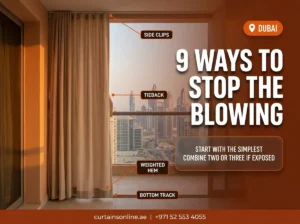
1. Use tiebacks or holdbacks
Tiebacks hold open curtains against a post, wall or railing so the wind cannot catch them.
- Fix a hook or holdback to the wall or post at about one-third of the curtain height.
- Gather the curtain and loop the tieback around it.
- Use rust-proof hooks: stainless steel or powder-coated metal. Dubai’s humidity rusts plain steel quickly.
Best for: Light breezes, covered terraces, days you want the curtains open.
2. Add weights to the hem
Weights pull the bottom of the curtain down so it stops lifting and flapping.
- Open the bottom hem (or ask a tailor to add a weight pocket).
- Slide in a lead-free weight chain or flat weights along the full width.
- Close the hem with stitching or hem tape.
If you do not want to sew, our curtain alterations team can add a weighted hem to your existing curtains.
Best for: Steady moderate breezes on covered balconies and terraces.
3. Use clip-on or magnetic curtain weights
Clip-on weights attach to the hem in seconds with no sewing. Magnetic weights snap together through the fabric.
- Clip one weight at each bottom corner.
- Add more along the hem, about every 30–40 cm, on wider panels.
- Remove them when you wash the curtains.
Best for: Renters, quick fixes, curtains you take down often.
4. Install a bottom rod
A second rod near the floor holds the bottom of the curtain in place, the same way the top rod holds the top.
- Fit a slim rod or tube 2–5 cm above the floor, directly below the top rod.
- Thread it through a bottom rod pocket, or use curtains with eyelets at both top and bottom.
- Fix the rod ends firmly to the posts, wall or railing.
The drilling and bracket steps are the same as a top rod. See how to install and hang curtains for the method.
Best for: Open balconies, pergolas and anywhere the wind is strong.
5. Run a tension cable along the bottom
A stainless-steel cable stretched tight between two posts acts like a bottom rod, but is lighter and easier to fit on long runs.
- Fix an eye bolt or cable bracket at each end, near the floor.
- Thread the cable through the bottom grommets or rings of the curtain.
- Tighten with a turnbuckle until it is taut.
Best for: Wide pergolas and cabanas where a long rod would sag.
6. Use top-and-bottom grommet curtains
Some outdoor curtains have eyelets (grommets) along both the top and bottom edges. They slide on a rod or cable at both ends, so the curtain can still open and close but cannot lift.
Best for: Pergolas and gazebos where you want to open and close curtains every day.
7. Add side clips, ties or hook-and-loop strips
When wind pushes the curtain sideways, fix the side edge to a post or railing.
- Clips: Strong spring clips on the railing hold the side edge.
- Ties: Short fabric ties sewn to the side edge, tied to a post.
- Hook-and-loop (Velcro) strips: One strip on the post, one on the curtain edge.
Best for: Corners of balconies and pergolas where wind enters from the side.
8. Choose heavier outdoor fabric
A heavier, tighter-weave fabric catches less wind and falls straighter than a light, open weave. Outdoor-grade acrylic or polyester is better than indoor fabric used outside. See the fabric section below for what works in Dubai sun.
Best for: New curtains, or replacing thin ones that never stop flapping.
9. Use smaller panels and less fullness
The more fabric you hang, the more wind it catches. Several narrow panels are easier to control than one wide one, and outdoor curtains do not need as much fullness as indoor curtains. Measure carefully using our guide on how to measure for curtains.
Best for: High-rise balconies and very windy spots.
How to Secure Outdoor Curtains by Setup

Every outdoor space catches wind differently. Here is what works best for the four most common setups in Dubai homes.
| Setup | Typical wind | Best fixes |
| High-rise balcony | Strong and gusty | Bottom rod or cable, side clips, smaller panels |
| Villa pergola or gazebo | Open on all sides | Top-and-bottom grommets, tension cable, tiebacks |
| Covered terrace or outdoor majlis | Mostly sheltered | Tiebacks, weighted hems |
| Poolside cabana | Open, plus splashes | Tension cable, quick-dry outdoor fabric, tiebacks |
High-rise balcony (Dubai Marina, JBR, Downtown)
Balconies on higher floors usually face stronger, gustier wind than villas. Anchor the bottom of every panel with a rod or cable, and add clips on the side edges. Keep panels narrow so there is less fabric to catch the wind.
Check first: Many towers have rules about what can be fixed to balconies. Ask your building management before drilling, and keep curtains well inside the railing so nothing can fall.
Villa pergola or gazebo (Arabian Ranches, the Springs, Palm Jumeirah)
A pergola is open on several sides, so wind can come from any direction. Use curtains with grommets at the top and bottom, running on a rod or cable at both ends. Tie them back to the posts when open.
Motorized outdoor screens are another option for large pergolas. See our guide to motorized curtains for how they work.
Covered terrace or outdoor majlis
A roof and back wall block most of the wind. Weighted hems and good tiebacks are usually enough here.
Poolside cabana
Curtains near a pool get wind and splashes. Use a bottom cable, quick-drying outdoor fabric, and tie them back when not in use so they dry in the sun.
How to Keep Outdoor Curtains From Blowing Without Drilling
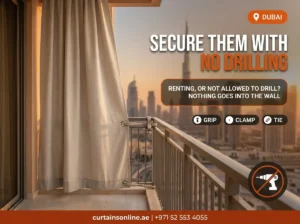
Renting, or not allowed to drill on your balcony? You can still secure outdoor curtains. These options grip, clamp or tie instead of screwing into the wall.
| No-drill method | How it works | Good for |
| Clip-on or magnetic weights | Clip onto the hem, no sewing | Light to moderate breeze |
| Tie to the railing | Ribbon, rope or Velcro ties from the hem to the balcony railing | Balconies with a solid railing |
| Clamp-on rail brackets | Brackets clamp onto the railing to hold a bottom rod | Balconies where a bottom rod is needed |
| Tension rod (bottom) | Spring rod wedged between two walls or posts | Recessed balconies with walls on both sides |
| Heavy planters or furniture | Stand them on the curtain hem or in front of it | Terraces and patios |
| Rope through the hem | Run a rope through the bottom hem and tie it to posts | Pergolas and gazebos |
Safety tip: On a balcony, never rely only on something that can blow loose or fall. Clamps and ties must be tight, and nothing should hang over the railing.
Best Fabric for Windy Outdoor Spaces in Dubai
For Dubai, choose an outdoor-rated fabric that handles wind and strong sun. Solution-dyed acrylic is the top choice for full sun, outdoor polyester is the budget choice, and PVC-coated mesh works where you want shade and airflow.
Sun matters as much as wind here. In solution-dyed acrylic, the colour is added before the fibre is made, which is why it resists fading so well. Outdoor polyester is cheaper and still offers good UV protection, but not the same colourfastness as solution-dyed fabrics.
| Fabric | Sun / fade resistance | Wind behaviour | Price | Best for |
| Solution-dyed acrylic | Excellent | Medium weight, falls well | $$$ | Full-sun balconies and pergolas |
| Outdoor polyester | Good | Light to medium, needs weights | $ | Covered terraces, budget projects |
| PVC-coated polyester mesh | Very good | Wind passes through the holes, so it flaps less | $$ | Sun screens, very windy spots |
| Canvas (treated cotton) | Fair, can fade and mould | Heavy, stays down well | $$ | Shaded, dry areas only |
| Indoor fabric | Poor | Light, catches wind | — | Not recommended outside |
Tip: A mesh or open-weave fabric lets some wind through, so it flaps much less than a solid panel. If you need full privacy and wind control together, use a solid fabric with a bottom rod or cable.
We supply outdoor curtains in For more on fabrics in our climate, read best curtains for Dubai heat and why curtains fade.
What to Do on Shamal and Sandstorm Days
When strong winds or a dust storm are forecast, tie your outdoor curtains tightly or take them down. Even well-anchored curtains can tear, or pull out their fixings, in very strong gusts.
- Check the NCM forecast or weather alerts in the morning.
- Close and tie every panel tightly to its post or railing.
- On high balconies, take light panels down completely.
- Move pots and loose furniture that the curtains could knock over.
- After the storm, shake out the sand and dust before it settles into the fabric.
- Check hooks, clips and brackets for damage before you open the curtains again.
How to clean sand and dust off outdoor curtains
- Shake each panel outside, or vacuum it with a brush attachment.
- Rinse with a hose from top to bottom to wash out fine dust.
- Spot clean marks with mild soap and a soft brush.
- Let the curtains dry fully in the sun before tying them back, so mould cannot grow in the folds.
Common Mistakes That Make Outdoor Curtains Blow More
| Mistake | Why it is a problem | The fix |
| Using indoor curtains outside | Light fabric catches wind and fades fast | Use outdoor-rated fabric |
| Panels too wide or too full | More fabric means more wind to catch | Use narrower panels and less fullness |
| Relying on weights alone on an open balcony | Strong gusts still lift weighted hems | Add a bottom rod or cable |
| Leaving panels loose all day | Constant flapping wears fabric and fixings | Tie them back when open |
| Plain steel hooks and clips | They rust in Dubai’s humidity and stain the fabric | Use stainless steel or powder-coated metal |
| Ignoring storm warnings | Curtains tear or pull fixings out | Tie tight or take down |
Already have bent rods, broken brackets or rusty hooks? Our curtain fixing team can repair or replace them.
DIY vs Professional Outdoor Curtain Installation
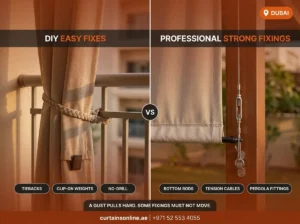
Tiebacks, clip-on weights and no-drill fixes are easy DIY jobs. Bottom rods, tension cables and pergola fittings are better done by a professional, because they need strong fixings that will not pull out in a gust.
| DIY | Professional | |
| Tiebacks and clip-on weights | Easy | Not needed |
| Weighted hems | Needs sewing | Done in our alterations workshop |
| Bottom rod or tension cable | Tricky to get tight and level | Fitted with outdoor-grade fixings |
| Pergola or gazebo systems | Hard to fix to posts safely | Measured and fitted to your structure |
| High-rise balcony fixings | Safety risk if done wrong | Safe fixings, checked against building rules |
| Cost | Hardware only | From [ADD: AED X] |
Enjoy Your Outdoor Space, Even on Windy Days
You now know how to keep outdoor curtains from blowing in the wind: match the fix to the wind, anchor the bottom on exposed balconies and pergolas, use outdoor-rated fabric, and tie everything down when a shamal is on the way.
Want curtains that are made and fitted for Dubai’s wind and sun from day one? Explore our outdoor curtains in Dubai, or book our curtain installation service for a free measurement visit. Call or WhatsApp +971 52 553 4055.
About the author: at Curtains Online, has fitted outdoor curtains on balconies, pergolas and terraces across Dubai. See our work in the project gallery.
Frequently Asked Questions
How do I stop outdoor curtains from blowing without drilling?
Use clip-on or magnetic weights on the hem, tie the bottom corners to the balcony railing, or use clamp-on brackets that hold a bottom rod on the railing. Heavy planters placed on the hem also help on terraces.
Are weighted hems enough for a Dubai balcony?
On a covered balcony with light to moderate breezes, yes. On open or high balconies where wind goes above 30 km/h, add a bottom rod or tension cable as well, because strong gusts can still lift a weighted hem.
What is the best fabric for windy outdoor areas?
Solution-dyed acrylic is the best all-round choice for Dubai because it resists sun fading and falls well. PVC-coated mesh flaps the least because wind passes through it. Avoid indoor fabrics outside.
Should I take outdoor curtains down during a shamal or sandstorm?
Yes, if you can. If not, close them and tie them tightly to posts or railings. Strong gusts above 40 km/h can tear fabric or pull fixings out of the wall.
How do I keep gazebo or pergola curtains from blowing?
Use curtains with grommets at both top and bottom, running on a rod or tension cable at each end. Tie them back to the posts when they are open.
Do outdoor curtain weights damage the fabric?
Not if you use smooth, rust-proof weights and spread them along the hem. Avoid plain metal that can rust, and remove clip-on weights before washing.
How do I clean sand and dust off outdoor curtains?
Shake or vacuum them, rinse with a hose from top to bottom, spot clean marks with mild soap, and let them dry fully in the sun before tying them back.